
In business, some decisions affect the next quarter. Others define the next decade. The ability to make those decade-defining decisions is called strategic thinking.
But what does that actually mean? As Saraf Academy’s founder, Prakash Saraf, explains it in the simplest terms:
“Strategy means any decision which will affect our long-term life… 5, 10, 15, 20 years, maybe for the whole life.”
This isn’t about day-to-day operations; it’s about seeing the future before it happens. Consider these real-world strategic challenges:
Making these high-stakes decisions requires a specific skillset-the ability to forecast, analyze competition, and align the entire organization behind a long-term vision. This is precisely the skillset that the IMA’s CSCA (Certificate in Strategy and Competitive Analysis) is designed to build. The CSCA certification is the premier global qualification for professionals who want to master the art and science of strategic leadership.
It’s crucial to understand that the CSCA certification is not an entry-level program. This is a specialized qualification created for experienced professionals who are already in, or aspiring to, senior leadership positions.
As Prakash Sir points out, the kind of strategic decisions the CSCA covers are not made by operational or mid-level managers.
“These types of decisions are not taken in the organization by a common man… these are taken at a senior level because strategic decisions require strategic thinking.”
The typical candidate profile for the CSCA course reflects this seniority. This is a qualification for those who want to advise the board of directors or join the C-suite.
The Ideal CSCA Candidate:
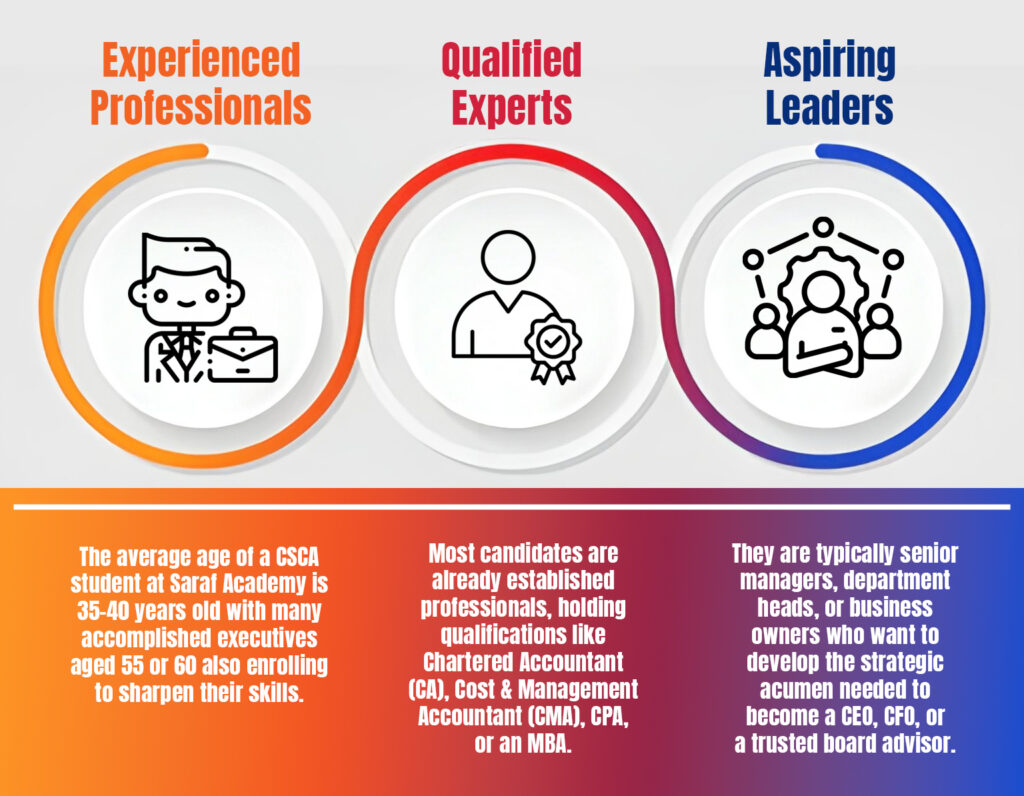
While the formal CSCA eligibility lists specific qualifications like CA and CMA, it also has a provision for “highly qualified senior executives with other backgrounds” to be approved based on their experience, making it accessible to proven leaders from various fields.
A great strategy isn’t magic; it’s the result of a structured, disciplined process. The CSCA syllabus is designed to give you a practical, end-to-end framework for developing and executing a winning business strategy.
The curriculum is broken down into three core pillars, which together form a powerful blueprint for leadership.
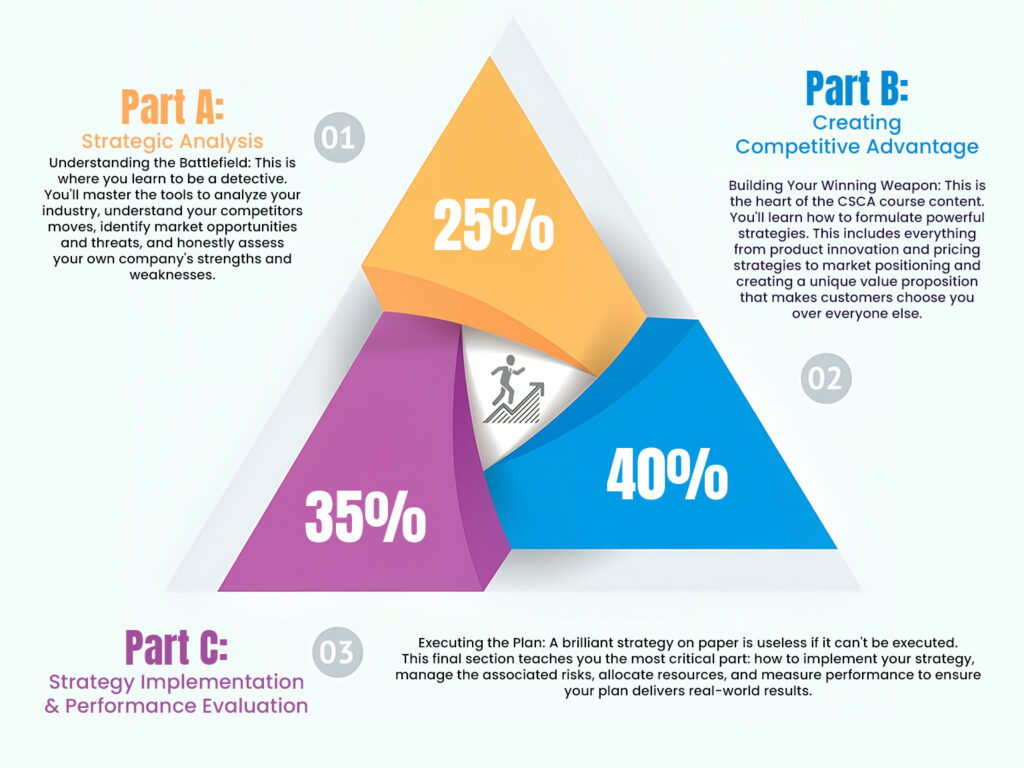
Together, these three parts of the CSCA syllabus provide a comprehensive and practical toolkit that moves you beyond theory and equips you to make impactful, long-term decisions in any industry.
The CSCA exam is designed not just to test what you know, but how you think. It’s a practical assessment of your ability to apply strategic concepts to real-world business challenges. Understanding its unique structure is the first step to success.
Here’s a clear breakdown of the CSCA exam pattern:
| Aspect | Details |
| Exam Duration | 3 Hours |
| Exam Windows | The entire months of March and September each year. |
| Total Marks | 400 |
| Passing Score | 280 (70%) |
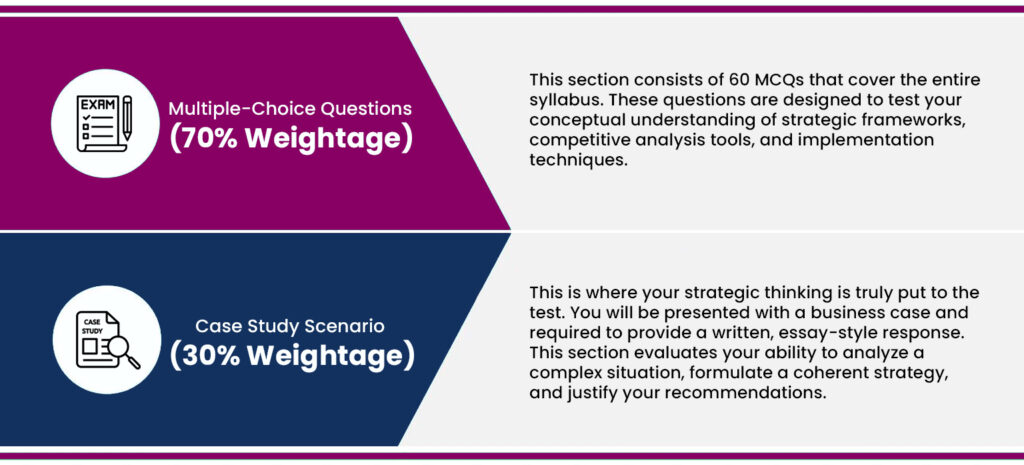
| Question Format | A combination of Multiple-Choice Questions and a Case Study. |
The Two Parts of the Exam
The exam is divided into two distinct sections to test different skills:
Why is the Passing Score 70%?
Many candidates are concerned about the high passing score. Prakash Sir provides a clear and logical explanation:
“Wherever multiple-choice questions are there, normally the passing marks would be definitely higher… even though you are not studying, out of four options, one option will definitely be correct… so for that reason, we can say that for multiple-choice exams, slightly the pass marks should be higher so that we can differentiate between a knowledgeable and a normal student.”
The 70% threshold ensures that the certification is awarded only to those who have a deep and genuine understanding of the material, maintaining the high standard and prestige of the CSCA designation.
A premium certification for senior professionals is a significant investment. At Saraf Academy, we believe in complete transparency, so you can make an informed decision. As Prakash Sir details in his sessions, the total CSCA certification cost is approximately ₹86,000.
This investment covers everything-your exam fees with the IMA, certified study materials, and expert live training.
Here is a clear comparison of the costs for a self-study approach versus the all-inclusive Saraf Academy package:
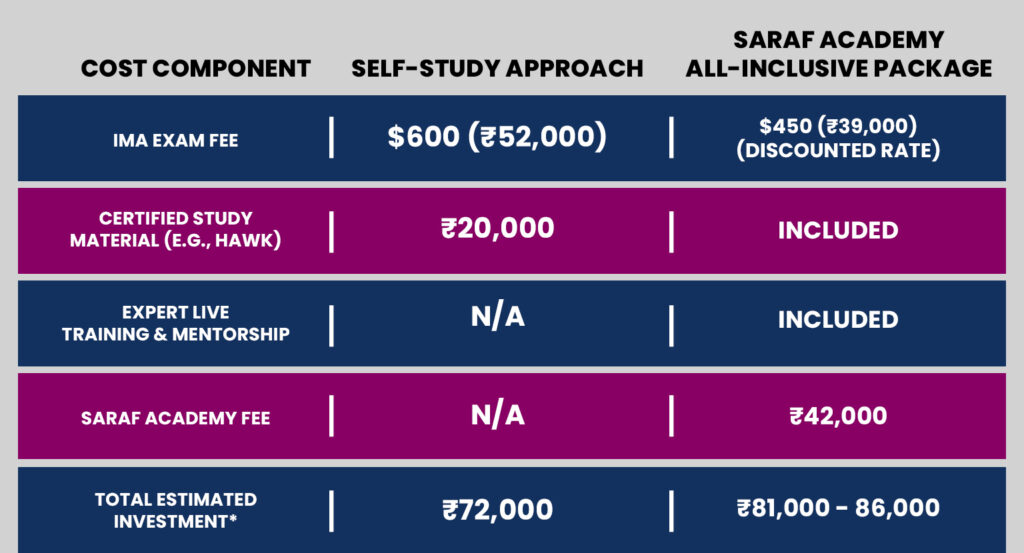
*Total investment can vary slightly based on the prevailing USD to INR exchange rate.
The Saraf Academy Value Proposition: As you can see, for a marginal additional investment, you get a significant discount on your IMA exam fee, certified study materials included for free, and over 100 hours of expert, live, case-study-based training. This comprehensive support system is designed to maximize your chances of passing on the first attempt, making it the most effective and valuable path to certification.
What is the return on investment for the CSCA? Will it get you a specific job or a guaranteed salary hike?
Prakash Sir addresses this question with the refreshing honesty of an experienced educator. The value of the CSCA is not a simple transaction; it’s a profound, long-term investment in your most valuable asset: your thinking process.
“I will never say that you should do this course and [you will get] this… The long-term goal is what? Whatever we learn, we will be able to apply in life… you will become the right hand, left hand, and sometime the directly the board member, CEO, CFO.”
So, is the CSCA worth it? The real ROI is not a specific job title but the development of a strategic mindset that makes you indispensable. The benefits include:
For professionals who are already qualified as CAs, CMAs, or CPAs, Prakash Sir uses a powerful metaphor:
“It is the icing on the cake.”
Your existing qualification is the solid foundation. The CSCA adds that final, crucial layer of strategic expertise that elevates you above your peers and prepares you for the highest levels of corporate leadership.
Mastering strategy isn’t about memorizing theories from a book; it’s about debating real-world business problems and sharpening your decision-making skills in a dynamic environment. This philosophy is at the core of the Saraf Academy experience, making it the best CSCA coaching available.
While the IMA suggests 30-50 hours of study, we believe that’s just the starting point.
“In my case, always the hours are more because I generally don’t prefer just only the syllabus-wise teaching… The purpose is more practical oriented study in place of just the bookish study.” – Prakash Saraf
Here’s what makes our CSCA online course different:
A Structure Designed for Senior Professionals: Our live classes are held at convenient times, such as Wednesday evenings and Saturday afternoons. The schedule also includes additional, exclusive sessions for CSCA candidates to cover specialized topics, ensuring a focused and comprehensive learning experience.
Since both the CSCA and the CMA (Certified Management Accountant) are prestigious certifications from the IMA, many professionals wonder: What’s the difference, and which one is right for me?
Understanding the distinct purpose of each qualification is key. They are not competitors; they are complementary steps on a leadership journey.
| Aspect | CMA (Certified Management Accountant) | CSCA (Certificate in Strategy & Competitive Analysis) |
| Primary Focus | Operational & Managerial Excellence: Focuses on the “inside” of the business-planning, budgeting, controlling, and decision support. | Long-Term & C-Suite Vision: Focuses on the “outside” world-competitive positioning, market trends, and long-range strategic planning. |
| Core Skills | Financial Planning, Performance & Analytics, Cost Management, Internal Controls. | Strategic Analysis, Competitive Intelligence, Strategy Formulation & Implementation. |
| Audience | Mid-to-senior level finance and accounting professionals. | Senior-to-executive level leaders (often already CAs, CMAs, CPAs). |
| Simple Analogy | The CMA helps you run the business efficiently today. | The CSCA helps you decide what business to be in tomorrow. |
The Bottom Line: The CMA is the foundational qualification for excellence in management accounting. The CSCA is the advanced, specialist certification for those who have mastered the operational side and are ready to step into a strategic leadership role. For an existing CMA, the CSCA is the perfect “next step” to move from management to the C-suite.
What is the ultimate goal of pursuing a professional certification? Is it just to pass an exam and hang a certificate on the wall?
At Saraf Academy, we believe the purpose is far deeper.
“The purpose is to get knowledge, knowledge, knowledge… skills which we can use in our life… for the whole life.” – Prakash Saraf
The CSCA certification is unique because its most valuable takeaway isn’t the physical certificate; it’s the intangible, permanent upgrade it gives your mind-a “strategic thinking process.”
This is more than just learning; it’s about fundamentally changing the way you view the business world. This new mindset enables you to:
Enrolling in the CSCA program is an investment in a new way of thinking-a skill that will pay dividends long after the exam is over, in every professional and personal decision you make.
Ready to start developing your strategic mindset? Contact us today.