
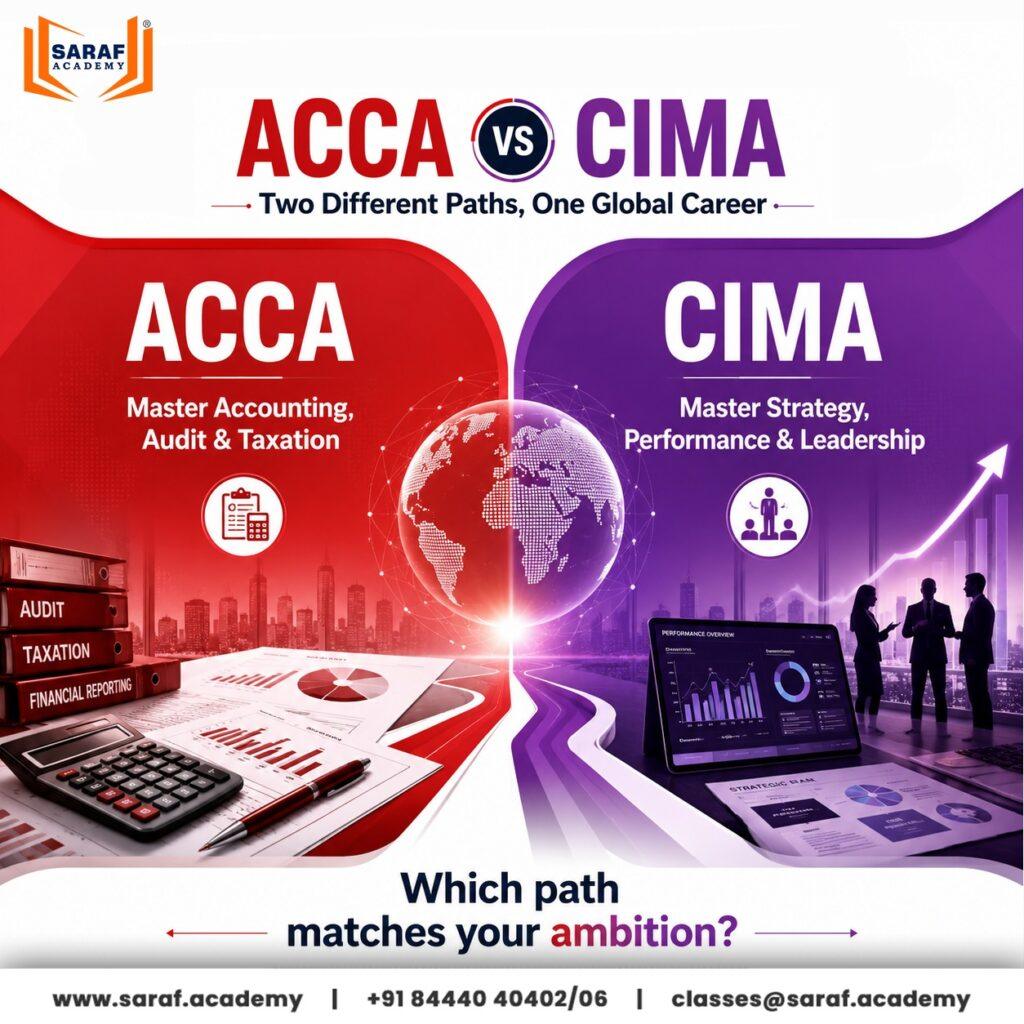
Choosing between ACCA vs CIMA can be challenging, especially for students planning a career in accounting and finance. However, with so many globally recognized qualifications available today, students often struggle to decide between ACCA and CIMA.
If you’ve been searching for “ACCA vs CIMA,” “Which is better: ACCA or CIMA?” or “Should I choose ACCA or CIMA after B.Com?”, you’re not alone.
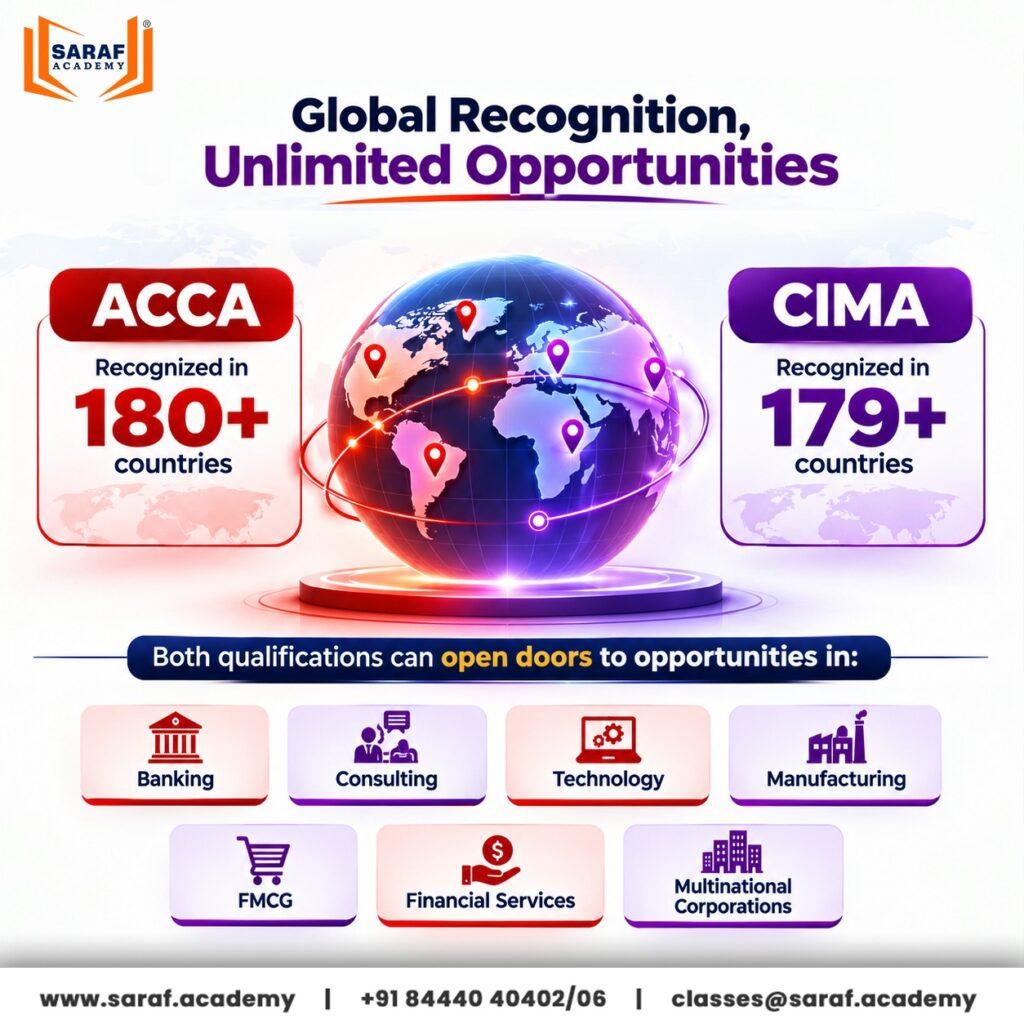
Both qualifications are internationally recognized, both originate in the UK, and both can open doors to excellent career opportunities across the world.
However, they are designed for different career paths.
In this comprehensive guide, we’ll compare ACCA and CIMA based on:
Let’s compare them side by side.
| Feature | ACCA | CIMA |
|---|---|---|
| Full form | Association of Chartered Certified Accountants | Chartered Institute of Management Accountants |
| Established | 1904 | 1919 |
| Primary focus | Accounting and auditing | Management accounting and strategy |
| Countries recognized | 180+ | 179+ |
| Total papers | 13 | 16 |
| Exemption | Up to 9 Papers | Up to 15 Papers |
| Duration (Based on Exemption) | 1-3 years | 6 month – 2 years |
| Best for | Accountants, auditors, tax professionals | Business leaders and management accountants |
| Global qualification | Yes | Yes |
| Flexibility | High | High |
The Association of Chartered Certified Accountants (ACCA) is one of the world’s most respected accounting qualifications.
Founded in the UK in 1904, ACCA is recognized in more than 180 countries and focuses on developing expertise in:
Students who complete ACCA become part of a global professional network and gain access to international career opportunities.
Learn more about the ACCA qualification here: https://saraf.academy/acca-course/
The Chartered Institute of Management Accountants (CIMA) is the world’s largest professional body for management accountants.
Unlike traditional accounting qualifications, CIMA focuses on helping professionals develop business, management, and leadership skills.
The qualification emphasizes:
CIMA professionals are often involved in organizational planning and corporate decision-making.
Learn more about the CIMA qualification here: https://saraf.academy/cima-course/
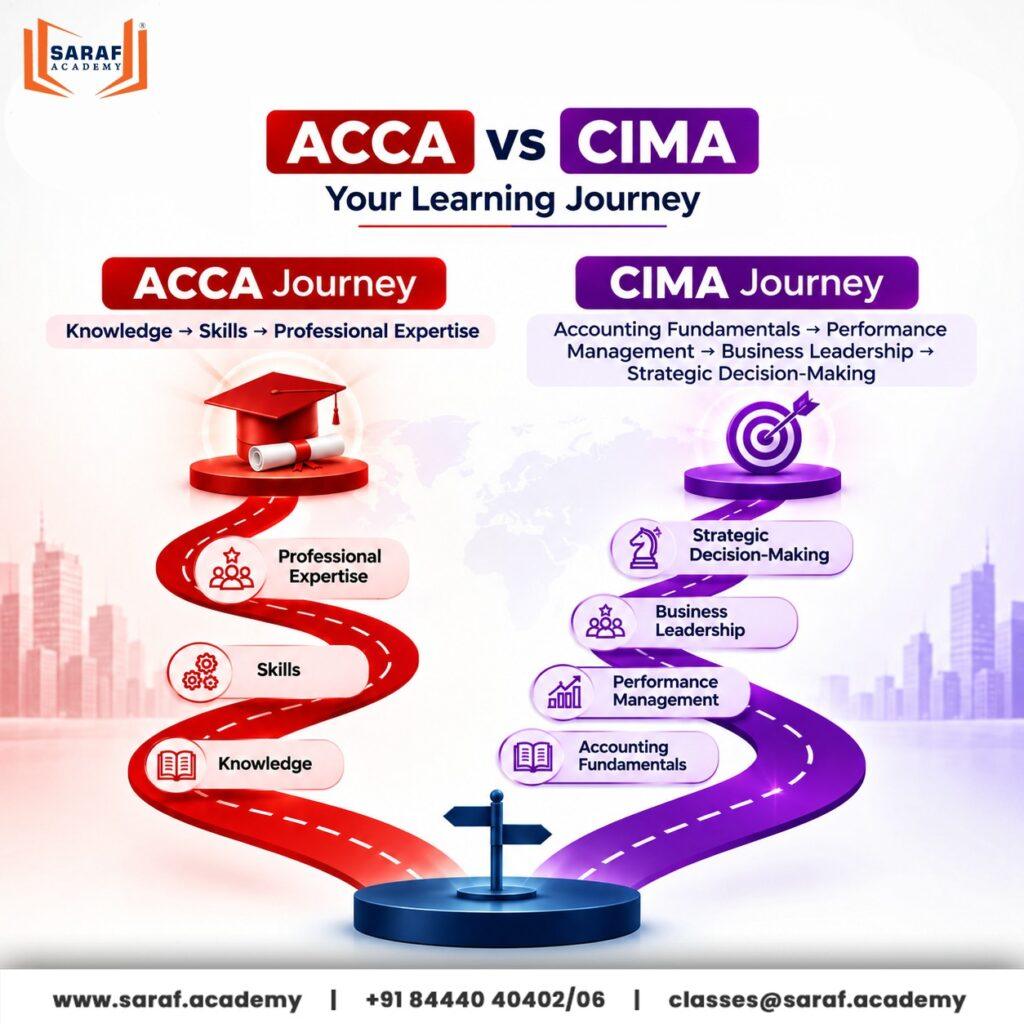
ACCA consists of 13 papers divided into three levels.
| Level | Papers |
|---|---|
| Applied Knowledge Level |
● Business and Technology (BT) ● Management Accounting (MA) ● Financial Accounting (FA) |
| Applied Skills Level |
● Corporate and Business Law (LW) ● Performance Management (PM) ● Taxation (TX) ● Financial Reporting (FR) ● Audit and Assurance (AA) ● Financial Management (FM) |
| Strategic Professional Level (Essential Papers) |
● Strategic Business Reporting (SBR) ● Strategic Business Leader (SBL) |
| Strategic Professional Level (Optional Papers – Choose Any Two) |
● Advanced Financial Management (AFM) ● Advanced Performance Management (APM) ● Advanced Taxation (ATX) ● Advanced Audit and Assurance (AAA) |
CIMA consists of 16 papers divided into four levels.
| Level | Papers |
|---|---|
| Certificate Level (4 Papers) | ● Business Economics (BA1) ● Management Accounting (BA2) ● Financial Accounting (BA3) ● Fundamentals of Ethics, Corporate Governance, and Business Law (BA4) |
| Operational Level (4 Papers) | Objective Tests ● Managing Finance in a Digital World (E1) ● Management Accounting (P1) ● Financial Reporting (F1) Case Study Examination |
| Management Level (4 Papers) | Objective Tests ● Managing Performance (E2) ● Advanced Management Accounting (P2) ● Advanced Financial Reporting (F2) Case Study Examination |
| Strategic Level (4 Papers) | Objective Tests ● Strategic Management (E3) ● Risk Management (P3) ● Financial Strategy (F3) Case Study Examination |
| Criteria | ACCA | CIMA |
|---|---|---|
| Class 12 Students | Eligible | Eligible (Only for students who have passed Class XII.) |
| B.Com Students | Eligible | Eligible |
| Graduates | Eligible | Eligible |
| MBA Students | Eligible | Eligible |
| CA Students/Professionals | Eligible | Eligible |
| CMA Students/Professionals | Eligible | Eligible |
| Working Professionals | Eligible | Eligible |
One of the biggest factors students consider when choosing between ACCA and CIMA is the exemption policy.
| Criteria | ACCA | CIMA |
|---|---|---|
| Entry Routes | Academic qualification-based exemptions | FLP, GPAP and CSEP pathways |
| B.Com | Eligible for up to 5 paper exemptions | Up to 3 Exams (Depending on Eligibility) |
| M.Com | Eligible for up to 5 paper exemptions | Up to 3 Exams (Depending on Eligibility) |
| CA Inter | Eligible for up to 7 paper exemptions | Up to 3 Exams (Depending on Eligibility) |
| CA | Eligible for up to 9 paper exemptions | Only 1 Exam to be given |
| CMA India | Eligible for up to 9 paper exemptions | Only 1 Exam to be given |
Note: CIMA may provide exemptions based on relevant work experience, with eligible candidates potentially receiving exemptions for up to 15 exams, subject to CIMA’s assessment and eligibility criteria.
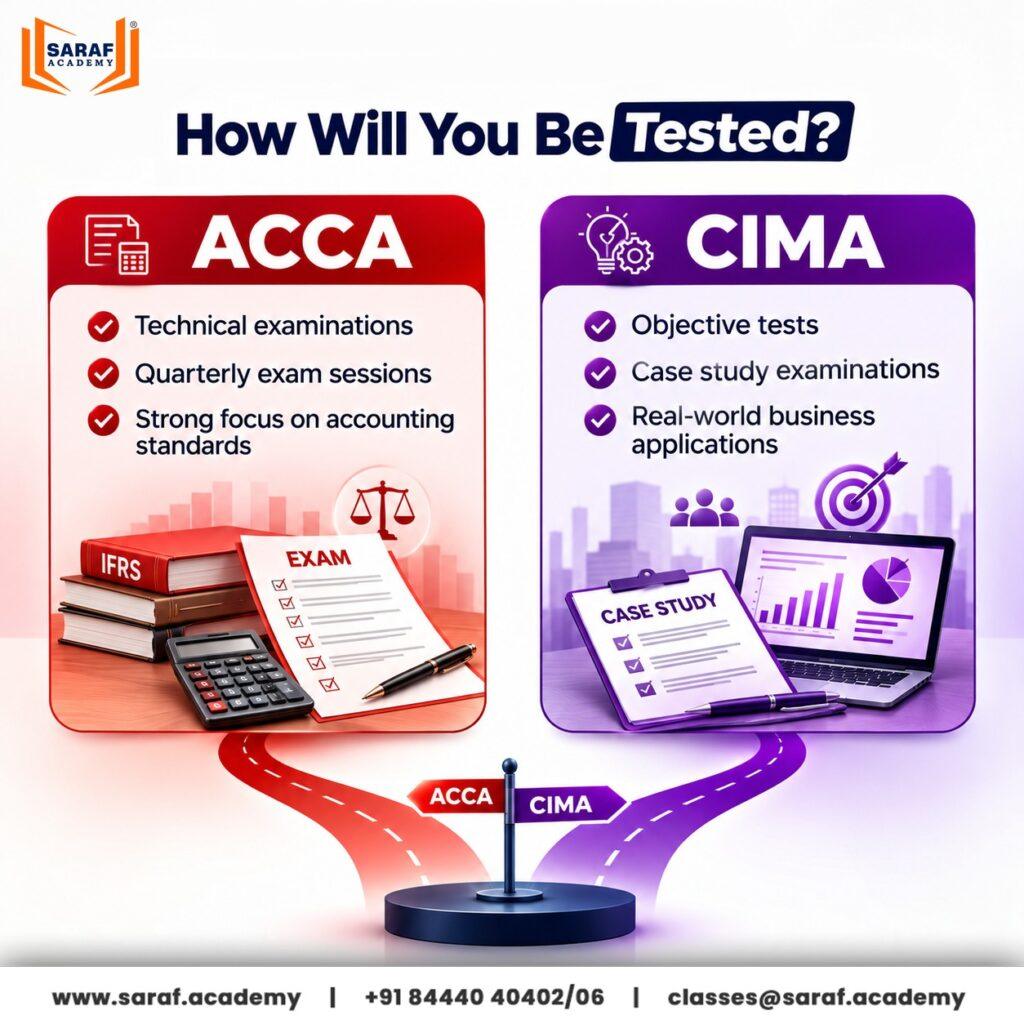
The exam pattern is one of the biggest differences between ACCA and CIMA. While both qualifications offer flexibility, they assess students in different ways.
| Criteria | ACCA | CIMA |
|---|---|---|
| Examination Pattern | ACCA follows a structured examination format. The Applied Knowledge exams are available on demand, while the remaining exams are conducted four times a year. | CIMA, through its a different pathways combines Objective Tests (OTs) and Case Study examinations. Objective Tests can be taken throughout the year, while Case Study examinations are conducted during specific windows. |
| Exam Sessions | ● March ● June ● September ● December | ● February ● May ● August ● November |
| Case Study Examinations | ACCA primarily focuses on technical accounting knowledge. | ● Operational Case Study (OCS) ● Management Case Study (MCS) ● Strategic Case Study (SCS) |
Unlike ACCA, which primarily focuses on technical accounting knowledge, CIMA evaluates a student’s ability to apply that knowledge to real-world business scenarios, making it particularly suitable for students interested in management and strategic decision-making.
The duration of both ACCA and CIMA depends on a student’s academic background, exemptions, study pace, and exam attempts.
| Student Profile | ACCA | CIMA |
|---|---|---|
| Class 12 Students | 3–3.5 years | 1–2 years |
| Graduates | 2–2.5 years | 1–2 years |
| CA/CMA Students | 18–24 months | 1–2 years |
| Qualified CA/CMA Professionals | Around 1 year | 6 months |
The total cost depends on:
Approximate total qualification cost:
You should always calculate the total cost before choosing a qualification.
ACCA Training Cost at Saraf Academy
Check the latest ACCA pricing here: https://saraf.academy/acca-course-pricing/
Check the latest CIMA pricing here: https://saraf.academy/cima-course-pricing/
The total cost may vary depending on exemptions, exam attempts, membership fees, and the coaching provider.
| Experience | ACCA Salary | CIMA Salary |
|---|---|---|
| Entry Level | ₹6-8 lakh | ₹5-8 lakh |
| Mid-Level | ₹8-15 lakh | ₹10-18 lakh |
| Senior Level | ₹20 lakh+ | ₹20 lakh+ |
Salary varies depending on location, employer, skills, industry, and experience.
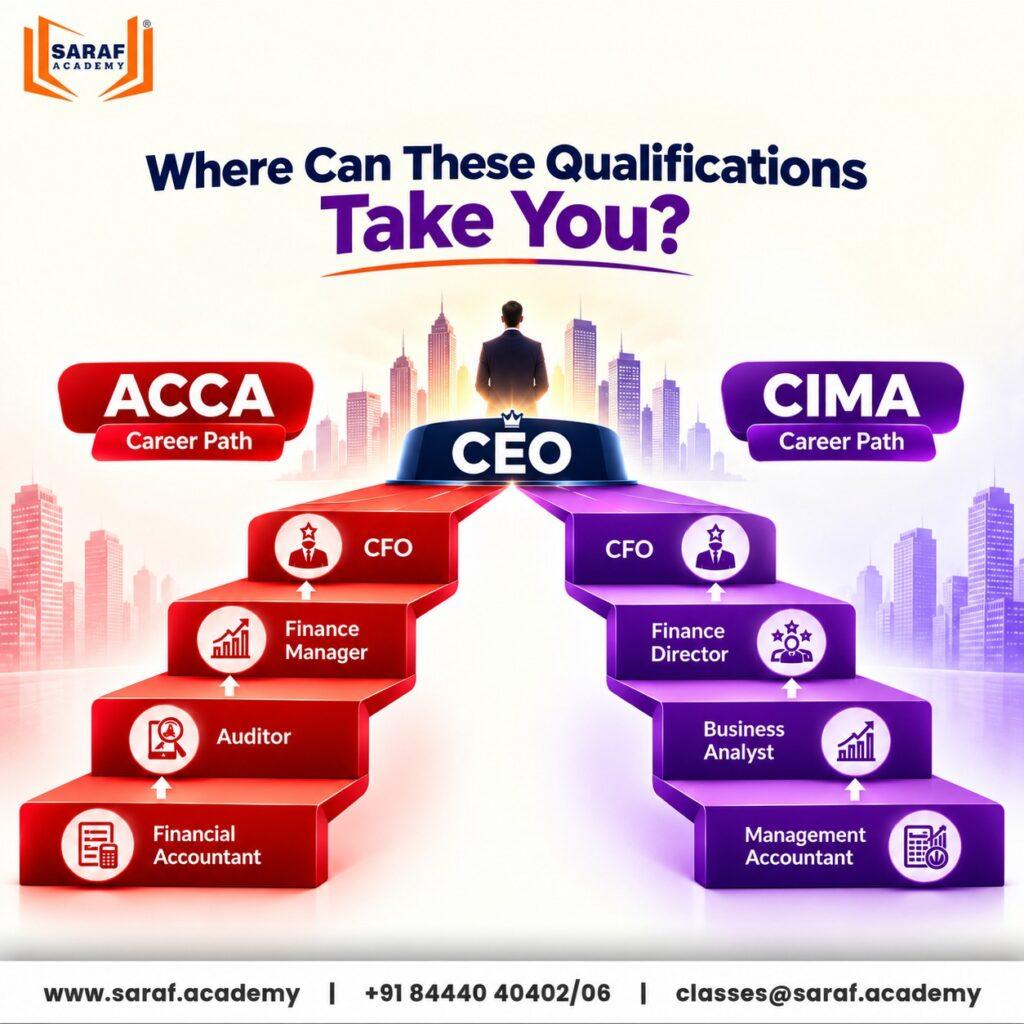
| Career Opportunities | ACCA | CIMA |
|---|---|---|
| Popular Job Roles | ● Auditor ● Tax Consultant ● Financial Accountant ● Internal Auditor ● Financial Analyst ● Finance Manager ● CFO ● CEO | ● Management Accountant ● Business Analyst ● Strategy Manager ● Performance Manager ● Financial Controller ● Finance Director ● CFO ● CEO |
| Industries | ● Manufacturing ● Consulting ● Technology ● FMCG ● Banking ● Corporate Finance ● Audit Firms ● Consulting Firms ● Financial Services ● Multinational Corporations | ● Manufacturing ● Consulting ● Technology ● FMCG ● Banking ● Corporate Finance ● Audit Firms ● Consulting Firms ● Financial Services ● Multinational Corporations |
If you’ve completed a B.Com degree, your choice should depend on your career goals.
There is no universal answer.
The best qualification is the one that aligns with your long-term career goals.
| Criteria | Choose ACCA If… | Choose CIMA If… |
|---|---|---|
| Interest | ● You enjoy numbers. ● You like auditing. | ● You enjoy solving business problems. ● You want to participate in strategic decision-making. |
| Career Goals | ● You want to become an accountant. ● You want to specialize in taxation and financial reporting. ● You want to work with accounting standards. | ● You want to become a business leader. ● You want to work closely with management teams. |
| Question | Answer |
|---|---|
| Is ACCA better than CIMA? | Neither qualification is better than the other. The right choice depends on your career goals. |
| Which qualification pays more, ACCA or CIMA? | Both qualifications offer excellent salary potential. Your salary will depend on your skills, experience, location, and employer. |
| Which qualification is easier? | Both ACCA and CIMA are challenging. However, the examination style and subject focus differ. |
| Can I pursue ACCA after B.Com? | Yes. B.Com graduates can pursue ACCA and may also be eligible for exemptions. |
| Can I pursue CIMA after B.Com? | Yes. CIMA offers multiple pathways for graduates. |
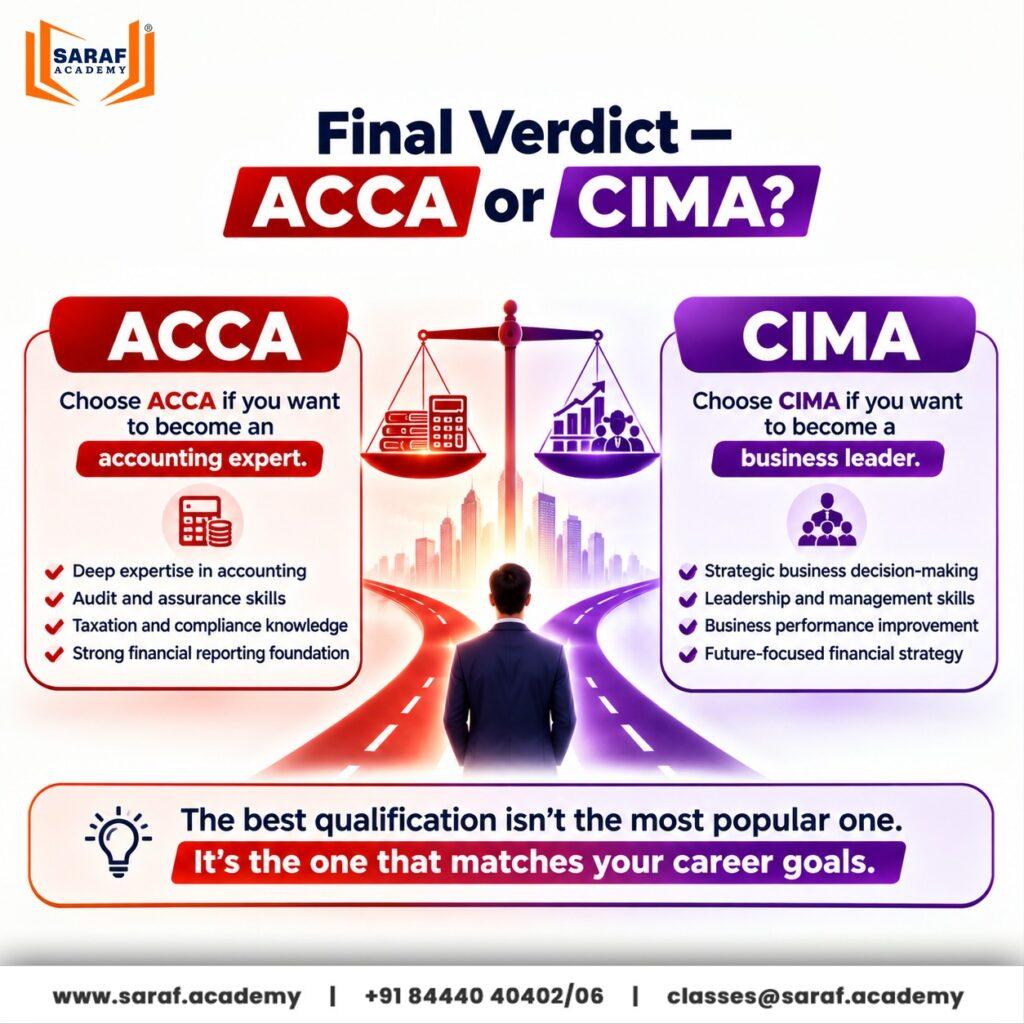
Choose ACCA if you want to become an accounting, auditing, taxation, or financial reporting expert.
Choose CIMA if you want to become a business strategist, management accountant, or finance leader.
Still confused?
Explore both programs and compare them in detail before making your decision.
Start your journey toward a globally recognized finance qualification today.