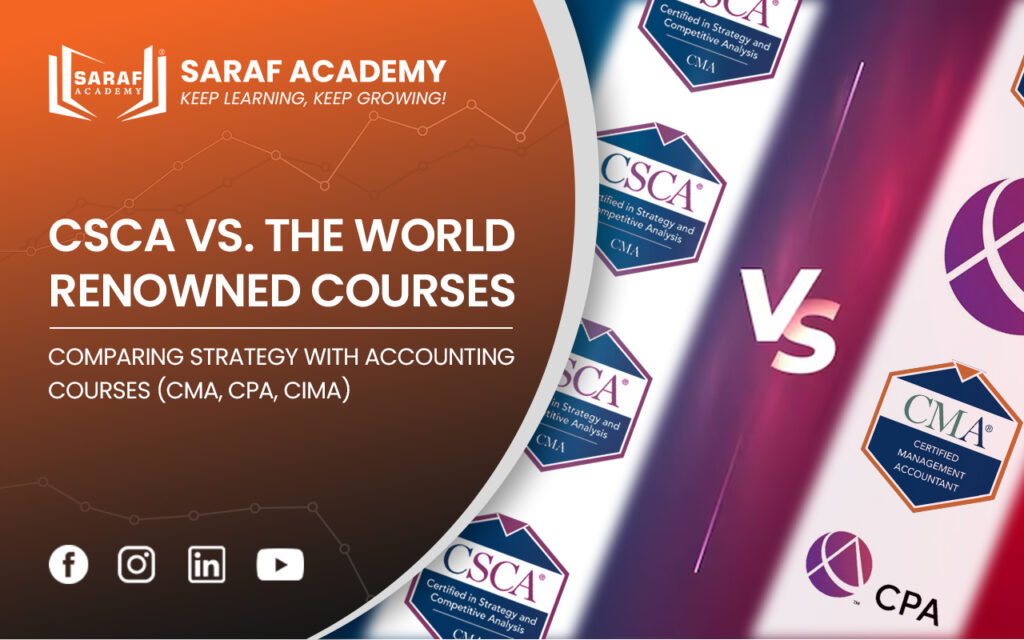
“Sir, should I do the CSCA instead of the CMA or CPA?”
This is a dangerous question. It stems from a fundamental misunderstanding of what the CSCA (Certified in Strategy and Competitive Analysis) actually is.
In the crowded marketplace of 2026, where every finance professional is waving a certification, confusion is natural. You have the heavyweights like CPA, CMA, and CIMA. And then you have this specialized, elite designation called CSCA.
Comparing them directly is like comparing a General Physician to a Neurosurgeon. One is the essential foundation; the other is a high-level specialization.
As a mentor who has guided senior professionals to the C-suite, I am here to clear the fog. We are not just going to compare acronyms; we are going to compare career trajectories.
In this definitive guide, we will pit the CSCA against the giants of the accounting world. We will analyze the syllabus, the intent, and the ROI of each to help you decide if you need a “Foundation” or if you are ready for the “Penthouse.”
1. The Core Distinction: The “Foundation” vs. The “Accelerator”
The most important thing to understand is that CSCA is not a substitute; it is an accelerator.
The Big Three (CPA, CMA, CIMA): These are “Foundational Professional Qualifications.” They teach you the language of business. They cover the A-to-Z of accounting, reporting, tax, and basic management. You build your career on them.
The Specialist (CSCA): This is a “Strategic Add-On.” It assumes you already know the numbers. It teaches you how to use those numbers to beat the competition.
The Analogy:
If the CMA or CPA is the “Engine” of the car that makes it run, the CSCA is the “Turbocharger” that makes it win the race.
In 2026: Automation has commoditized the “Engine” work (reporting, compliance). The premium value is now in the “Turbo” work (strategy, foresight). That is why the CSCA is gaining massive traction among senior leaders.
2. CSCA vs. CMA (US): The “Parent” vs. The “Child”
This is the most common comparison because both are offered by the IMA (Institute of Management Accountants). In fact, until recently, you had to be a CMA to sit for the CSCA.
Feature
CMA (Certified Management Accountant)
CSCA (Certified in Strategy & Competitive Analysis)
Strategic Management: Competitive intelligence, game theory, innovation strategy, long-term planning.
Scope
Broad: Covers the entire finance function.
Niche: Laser-focused on the “Strategy” domain.
Audience
Mid-Level Professionals: Analysts, Managers, Controllers looking to solidify their base.
Senior Leaders: CFOs, VPs, Directors who need to sit at the boardroom table.
Exam
2 Parts (8 Hours Total): Intense, broad coverage.
1 Part (3 Hours): Case-study driven, focused.
The Verdict:
Do CMA First: If you are building your career foundation. It is the prerequisite for a reason.
Do CSCA Next: Once you are a CMA, the CSCA is the “icing on the cake.” It distinguishes you from the 100,000 other CMAs by proving you are not just a “Cost Accountant” but a “Strategic Thinker.”
3. CSCA vs. CPA (US): The “Rule Follower” vs. The “Rule Breaker”
The CPA (Certified Public Accountant) is the gold standard of public accounting. The CSCA is the gold standard of strategic analysis. They are opposites in almost every way.
The CPA Mindset (Compliance): A CPA looks at the past. They ensure the financial statements are accurate, the taxes are filed correctly, and the laws are followed. Their job is to minimize risk and ensure compliance.
Key Phrase: “Is this correct according to US GAAP?”
The CSCA Mindset (Strategy): A CSCA looks at the future. They analyze competitors, assess market trends, and recommend bold moves to gain market share. Their job is to take calculated risks to drive growth.
Key Phrase: “How can we disrupt the market to double our margins?”
The 2026 Reality:
In 2026, AI handles much of the CPA’s routine compliance work. However, AI cannot yet replicate the human strategic intuition taught in the CSCA.
The Verdict:
Choose CPA: If you want to be an Auditor, Tax Consultant, or specialize in Financial Reporting.
Choose CSCA: If you are a CPA who is tired of “checking boxes” and wants to move into a specialized Corporate Strategy or CFO role.
4. CSCA vs. CIMA (UK): The “Specialist” vs. The “Generalist Strategist”
CIMA (Chartered Institute of Management Accountants) is a massive, comprehensive qualification that includes strategy as part of its final level. How does the specialized CSCA compare?
CIMA (The Long Haul): CIMA is a 3-4 year journey (for beginners). It builds you up from basic accounting to strategic management. Strategy is one part of the Strategic Level exams.
CSCA (The Deep Dive): CSCA takes that “Strategy” component and expands it into a dedicated masterclass. It goes deeper into concepts like Porter’s Five Forces, Blue Ocean Strategy, and Scenario Planning than CIMA does.
The Qualification Gap:
CIMA is a full professional designation (like a degree).
CSCA is a certification (like a specialized diploma).
The Verdict:
If you are starting from scratch in India or the UK, CIMA is a complete career path.
If you are already qualified (CA, CMA, MBA) and feel your “strategic” skills are weak, CSCA is the fastest, most effective way to plug that gap without spending years on another degree.
5. The Syllabus Showdown: What Do You Actually Learn?
To understand the difference, you have to look at the books.
What you learn in CMA/CPA/CIMA:
How to prepare a Balance Sheet.
How to calculate Variance.
How to audit Internal Controls.
How to compute Corporate Tax.
What you learn ONLY in CSCA:
Competitive Intelligence: How to legally spy on your competitors and predict their next move.
Strategic Positioning: Deciding whether to be the “Low Cost Leader” (Walmart) or the “Differentiator” (Apple).
Game Theory: Using mathematical models to predict outcomes in competitive situations.
Innovation Strategy: How to manage R&D and product launches to ensure they don’t flop.
My Insight: Most accountants are terrible at these things. We love certainty; strategy is about ambiguity. The CSCA teaches you how to be comfortable navigating the unknown.
6. Who is Eligible? The “Exclusive Club” Factor
This is a critical differentiator.
Open Access (ACCA/CIMA): Anyone can join after high school. It is a mass-market qualification.
Restricted Access (CSCA): You cannot just walk in off the street.
Historically, you had to be an active CMA or CFM.
Recently, IMA expanded eligibility to holders of other prestigious certifications (like CPA, ACCA, CFA) and those with significant senior leadership experience.
Why this matters: When you hold a CSCA, it signals that you are already part of an elite group. You have already cleared the hurdle of a base qualification. It is a “post-graduate” level signal to employers.
7. Career Impact: The “Controller” vs. The “CFO”
In the corporate hierarchy of 2026, where does each certification land you?
The Controller Track (CPA / CMA alone):
Role: You own the books. You close the month, report the numbers, and manage the audit.
Ceiling: You can reach the “Financial Controller” or “VP of Finance” level comfortably.
The Gap: To jump from Controller to CFO, you need to prove you can help the CEO run the business, not just count the money.
The CFO Track (CPA/CMA + CSCA):
Role: You own the future. You advise the CEO on mergers, acquisitions, new market entries, and long-term capital allocation.
The Advantage: The CSCA gives you the vocabulary to talk to the Head of Marketing and the Head of Sales on their terms. It bridges the gap between “Finance” and “Business.”
Real World Truth: Recruiters for CFO roles in 2026 are looking for “Strategic Finance” skills. The CSCA is tangible proof of that skill.
8. The Cost & Time Investment: A Fraction of the Effort
Here is the practical argument for the CSCA.
CPA/CIMA: Requires 12-24 months of intense study and costs ₹2 – 4 Lakhs. It is a lifestyle commitment.
CSCA:
Time: Can be completed in 3-4 months (with 60-80 hours of study).
Cost: Approximately ₹85,000 – ₹90,000.
Exam: One single exam. No multi-level groups.
The ROI Calculation:
For a fraction of the time and cost of a new master’s degree, you add a premium, globally recognized designation to your name. It is one of the highest ROI investments for a working professional.
9. The Final Verdict: When to Choose What?
Let’s simplify this complex decision into a final checklist for 2026.
1. Choose CMA or CPA or CIMA IF:
You are a student or in the first 5 years of your career.
You need a strong technical foundation to get hired.
You want to work in core Accounting, FP&A, or Audit roles.
These are your “Bread and Butter.”
2. Choose CSCA IF:
You are already qualified (CMA, CPA, CA, ACCA).
You feel stuck in operational/reporting roles and want to move to Strategy.
You want to differentiate yourself from the thousands of other accountants in the job market.
You are aiming for the C-Suite.
This is your “Secret Weapon.”
The Mentor’s Advice:
Do not see this as a “Versus” battle. See it as a “Stack.”
The most powerful profile in 2026 is the CMA + CSCA or the CPA + CSCA.
This combination tells the world: “I know the numbers better than anyone, AND I know how to use them to win.”
Upgrade Your Career to Strategic Leadership with Saraf Academy!
Whether you are building your foundation with CMA/CPA or adding the strategic edge with CSCA, Saraf Academy is your partner in excellence.
For the CSCA: We offer an exclusive, case-study-driven program that goes beyond the textbook. We debate real-world strategies of companies like Amazon and Tesla to build your strategic muscle.
For CMA/CPA: Our intensive, mentor-led batches ensure you clear these rigorous exams on your first attempt.
Don’t just be an accountant. Be a strategic leader.