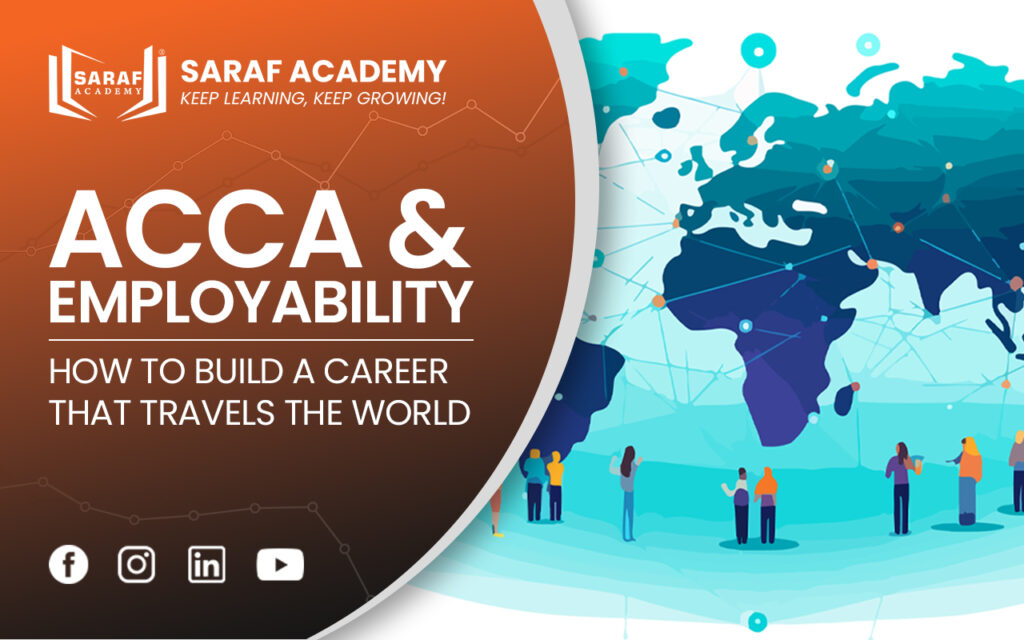
ACCA & Employability [2026]: How to Build a Career That Travels the World
“Sir, will this course get me a job?”
In 2026, this is the only question that matters. The days of studying for “knowledge alone” are gone. We live in a hyper-competitive, AI-driven economy where a generic degree is no longer a safety net.
Students today are facing an “Employability Crisis.” They have degrees, they have marks, but they don’t have skills. Employers are tired of retraining freshers. They want professionals who are “Day 1 Ready.”
This is where the ACCA (Association of Chartered Certified Accountants) changes the game.
ACCA isn’t just a syllabus; it is a global employability framework. It is designed not to make you an academic, but to make you a highly sought-after professional asset. Whether you are in Mumbai, Manchester, or Melbourne, the ACCA badge signals one thing to employers: “This person knows business.”
In this definitive guide, we will deconstruct exactly how ACCA turns you into a global finance leader. We will look beyond the exams to the real-world skills, the global mobility, and the career acceleration that defines the ACCA journey in 2026.
1. The “Degree vs. Skill” Gap: Why ACCA Wins in 2026
Let’s look at the harsh reality of the 2026 job market.
The Academic Trap: A typical university degree teaches you the history of finance. You learn theories from textbooks written ten years ago. You pass by memorizing definitions.
The Professional Reality: A modern finance job requires you to apply concepts to messy, real-world data. You need to know how to use accounting software, how to interpret international standards, and how to communicate bad news to a client.
The ACCA Difference:
ACCA bridges this gap effectively. The curriculum is updated annually to reflect what employers actually need.
When you study Audit & Assurance (AA), you aren’t just learning definitions; you are learning how to assess risk in a real company.
When you study Strategic Business Leader (SBL), you are role-playing as a consultant solving actual business crises.
The Mentor’s Insight: “Employers don’t pay for what you know. They pay for what you can do. ACCA teaches you to do.”
2. The Global Passport: Mobility in a Borderless World
Most qualifications anchor you to a specific country. If you study Indian Tax Law, you are valuable in India, but your value drops the moment you cross the border.
ACCA is different. It is built on IFRS (International Financial Reporting Standards), the universal language of business used in over 140 countries.
The Mobility Factor:
The “Middle East” Rush: In 2026, the UAE and Saudi Arabia are booming markets for finance professionals. They prioritize ACCA because it is an international benchmark.
The “Western” Dream: Countries like the UK, Canada, Australia, and Singapore have massive talent shortages in accounting. ACCA is their preferred qualification for skilled migration.
The “Remote” Reality: You can sit in Bangalore and work for a London-based firm. Why? Because you both speak the same financial language (ACCA/IFRS).
The Bottom Line: ACCA doesn’t just give you a job; it gives you the freedom to choose where you do that job. It is your visa to the world.
3. The “T-Shaped” Professional: Depth + Breadth
In 2026, recruiters are looking for “T-Shaped Professionals.”
The Vertical Bar (Depth): Deep technical expertise in one area (e.g., Audit or Tax).
The Horizontal Bar (Breadth): Broad understanding of other business functions (Strategy, Technology, Leadership).
Many specialized masters degrees give you only the vertical bar. A general MBA gives you only the horizontal bar.
ACCA gives you the full “T”.
Technical Mastery: Papers like Financial Reporting (FR) and Financial Management (FM) ensure your technical base is rock solid.
Strategic Breadth: The Strategic Professional level forces you to look at the bigger picture-ethics, governance, digital strategy, and leadership.
This combination makes ACCA members uniquely employable because they can talk to the IT department, the HR department, and the Board of Directors with equal confidence.
4. The “GCC” Explosion: Why India is the Sweet Spot
We cannot talk about employability without talking about the Global Capability Centers (GCCs) in India.
By 2026, India hosts over 2,000 GCCs-offshore HQs for giants like Barclays, Shell, Ford, and Tesco. These centers are not doing data entry; they are running global finance operations.
The Problem: These GCCs operate on global standards. They cannot hire someone who only knows local GAAP.
The Solution: They hire ACCAs aggressively.
Why GCCs Love ACCA:
Standardization: An ACCA in India has passed the exact same exam as an ACCA in the UK. The employer knows the quality is guaranteed.
Communication: ACCA exams (especially the professional level) require extensive written communication. This ensures that the employee can write professional reports for stakeholders in London or New York.
The Mentor’s Insight: “If you want a high-paying corporate job in India without moving abroad, ACCA is the golden key to the GCC sector.”
5. Future-Proofing: Digital Quotient and Sustainability
The two biggest disruptors in finance today are Technology (AI/Automation) and Sustainability (ESG).
If your qualification ignores these, you are obsolete before you graduate.
Digital Intelligence: ACCA was the first body to integrate digital skills into every paper. You don’t just learn accounting; you learn about Cloud Computing, Big Data, Blockchain, and FinTech. You learn how to audit an AI algorithm and how to manage cyber risk.
Green Finance: In 2026, companies must report on their carbon footprint just as accurately as their profits. ACCA integrates ESG (Environmental, Social, and Governance) reporting into its core syllabus.
The Result: You graduate not as a “traditional accountant,” but as a “sustainable business leader” ready for the modern economy.
6. The “Competency Framework”: Designed by Employers, For Employers
Here is a secret most students don’t know: ACCA doesn’t design its syllabus in isolation.
They use a Global Competency Framework. Every year, ACCA consults with thousands of top employers (CEOs, CFOs, HR Directors) and asks: “What skills are you missing? What do you need in the next 5 years?”
They then reverse-engineer the exams to teach those specific skills.
The 7 Vital Skills ACCA Builds:
Technical & Ethical: The core accounting skills + a strong moral compass.
Intelligence: Reasoning and problem-solving.
Creative: Innovation and skepticism.
Digital: Tech-savviness.
Emotional: Interpersonal skills and empathy.
Vision: Strategic thinking.
Experience: Practical application.
When you walk into an interview with an ACCA affiliate status, the employer knows you have been trained on this exact framework. You are the puzzle piece they were looking for.
7. From Fresher to CFO: The Career Trajectory
Employability isn’t just about getting your first job. It’s about getting your best job 10 years from now.
ACCA is one of the few qualifications that stays relevant at every stage of your career.
Value: Managing teams and processes. ACCA’s management accounting papers help you run budgets and teams.
Stage 3 (8-15+ Years): The Leader.
Roles: CFO, Partner, CEO.
Value: Strategy and Governance. The “Strategic Business Leader” (SBL) paper prepares you specifically for this boardroom environment.
The Verdict: ACCA grows with you. It is a lifelong partner in your career climb.
8. The “Oxford Brookes” Edge: Two Degrees, One Effort
This is a unique employability booster that gives ACCA students a massive advantage.
Through a unique partnership, ACCA students can earn a B.Sc (Hons) in Applied Accounting from Oxford Brookes University (UK) while completing their ACCA exams. You don’t need to go to the UK; you submit a research project.
Why this matters for employability:
Academic Credibility: Some employers (especially in government or traditional sectors) still insist on a “University Degree.” This gives you a prestigious UK degree.
Research Skills: The project forces you to analyze a real company deeply, honing your research and analytical skills-traits that interviewers love.
9. A Mentor’s Guide: How to Convert “ACCA” into “Hired”
So, you have the qualification. How do you get the job? Here is my practical advice for 2026.
Start Early: Don’t wait to finish all 13 papers. You are employable after the “Applied Skills” level (9 papers). Start working then. Experience + Exams = Success.
Leverage the Portal: Use the ACCA Careers Job Board. It is one of the largest finance job boards in the world, exclusive to members and students.
Network Globally: Attend ACCA member events in your city. Connect with Saraf Academy alumni working in Big 4 firms. Your network is your net worth.
Showcase “Soft Skills”: In the interview, don’t just talk about IFRS standards. Talk about “Ethics,” “Strategy,” and “Communication.” These are the ACCA superpowers.
The Final Word:
In a world of uncertainty, skills are the only currency that holds value. ACCA is a global currency. It tells the world that you are competent, ethical, and ready for the future.
Don’t just study to pass. Study to lead.
Launch Your Global Career with Saraf Academy!
At Saraf Academy, we don’t just teach the syllabus; we build careers. We understand that your goal isn’t just a certificate-it’s a high-growth career.
Real-World Context: Our faculty includes industry experts who explain how ACCA concepts apply in real boardrooms.
Placement Support: We actively guide our students on resume building, interview prep, and connecting with top recruiters.
Global Community: Join a network of thousands of successful alumni working in top firms across India, the UK, and the Middle East.