
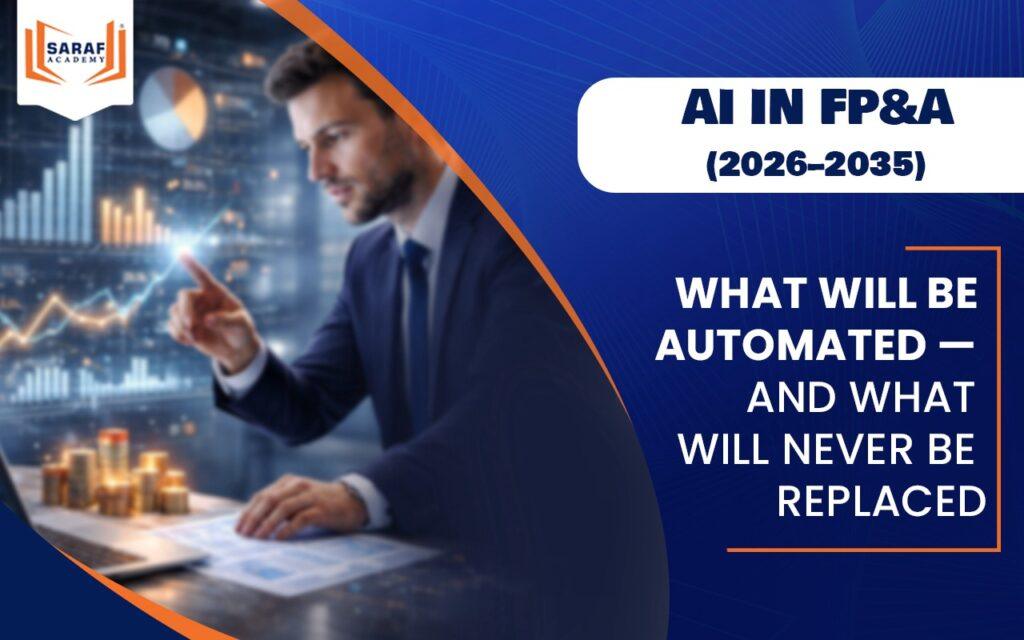
Artificial Intelligence is no longer a future concept in finance — it is already reshaping FP&A functions across industries.
Dashboards are automated. Forecasts are algorithm-assisted. Reports are generated in seconds.
But here is the strategic reality:
AI will change how FP&A operates — it will not replace why FP&A exists.
Let’s break this down clearly and practically.
AI-powered systems now automate:
Instead of spending days preparing reports, finance teams can now focus on interpretation.
Impact: Time shifts from preparation to performance analysis.
Modern AI tools can:
These tools increase speed and depth of analysis.
However, AI models rely on historical data.
They cannot understand political uncertainty, regulatory shifts, or leadership strategy shifts without human input.
AI excels at:
This reduces repetitive work and improves accuracy.
But automation here enhances FP&A — it does not replace it.
Now we move to the irreplaceable layer.
AI generates outputs.
It does not assume accountability.
FP&A professionals:
Board-level decisions require:
These are human competencies.
Finance is built on integrity.
Questions like:
Is revenue recognition appropriate?
Are assumptions overly optimistic?
Is risk being transparently communicated?
Ethical frameworks embedded in global bodies such as:
cannot be replicated by algorithms.
AI does not hold fiduciary responsibility.
Finance professionals do.
Modern FP&A has evolved into:
Business partnering requires:
AI can produce insights.
It cannot lead conversations.
Data does not drive decisions — clarity does.
FP&A leaders must:
AI may summarize data.
It cannot read executive dynamics.
The professionals at risk are not finance professionals.
The risk lies with those who:
The future FP&A leader will combine:
Finance + Analytics + Communication + Ethics
To build AI awareness without expensive courses, here are structured free resources:
Official free learning paths covering AI fundamentals, automation, and Power BI:
https://learn.microsoft.com/en-us/training/
Beginner-friendly AI and business analytics courses with certificates:
https://skillsbuild.org/
Free strategic finance, digital transformation, and AI articles:
https://www.mckinsey.com/featured-insights
Free summaries on finance technology and automation trends:
https://www.gartner.com/en/insights
Strategy, leadership, and decision-making insights:
https://hbr.org/
AI for business and analytics courses (content access free, certificate optional):
https://www.coursera.org/
By 2035, FP&A will:
But it will still require:
The correct hierarchy remains:
– Qualification
– Business judgment
– Communication
– Technology support
Not the reverse.
AI will automate mechanics.
It will enhance speed.
It will increase analytical capability.
But it will not replace:
AI prepares numbers.
FP&A professionals prepare decisions.
The winners of 2026–2035 will not be dashboard operators.
They will be strategic finance leaders who know how to use AI — without depending on it.