
For ambitious finance professionals in India, one of the biggest career questions is: should I pursue an Indian qualification or an international one? The CPA US course stands out as a premier global option, but it’s essential to begin with an honest perspective.
Many believe that international courses are an easier path. However, as an educator with over 30 years of experience, Prakash Saraf is quick to correct this myth.
“Do we want to say that international courses are easier to crack? No. Not a single international course which is recognized is easier than Indian CA… to pass. Don’t think like that.”
The real advantage of international courses like the CPA US isn’t about easier content; it’s about a smarter, more flexible structure designed for the modern professional. Here’s what sets it apart:
The CPA US isn’t an easy shortcut, but it is a flexible and highly practical pathway for dedicated professionals aiming for a globally recognized credential.
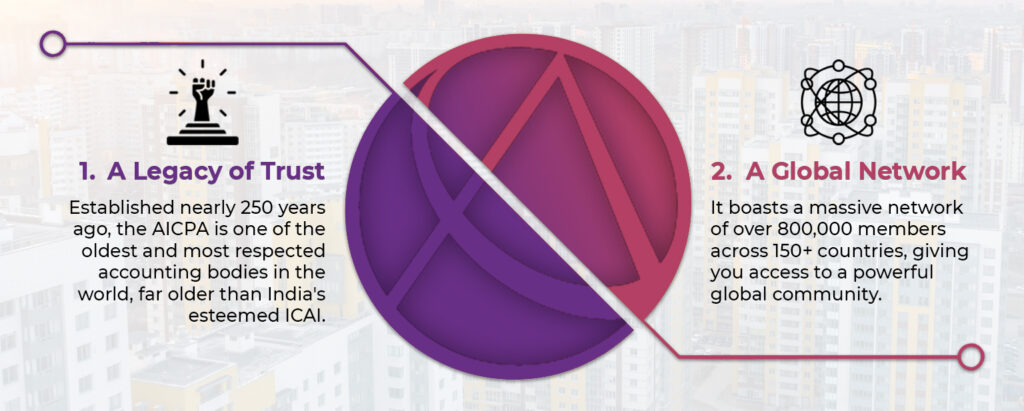
What gives the US CPA designation its immense power and prestige? The answer lies in the unparalleled legacy of its governing body and the global influence of the US economy.
The CPA US license is awarded by the AICPA (American Institute of Certified Public Accountants), an institution with a formidable history.
Prakash Sir frames the value perfectly by connecting it to the US’s role as a global “superpower.”
“US companies have their business all over the world… So US companies want CPA certified persons because in the course they are teaching US tax, US laws, US regulations.”
Because US business practices – including US GAAP, Auditing Standards, and Tax Laws – are the benchmark for many global corporations, holding a CPA license makes you fluent in the language of international business. It acts as your “global passport,” unlocking opportunities not just in the United States, but with the thousands of US-based multinational corporations and Global Capability Centres (GCCs) operating right here in India.
For many finance aspirants in India, the ultimate question is: CPA vs. Indian CA? Both are excellent qualifications, but they are built on fundamentally different philosophies of learning and examination. Understanding these differences is key to choosing the right path for your career goals.
Based on Prakash Sir’s experience teaching both Indian and international courses, here is a practical comparison:
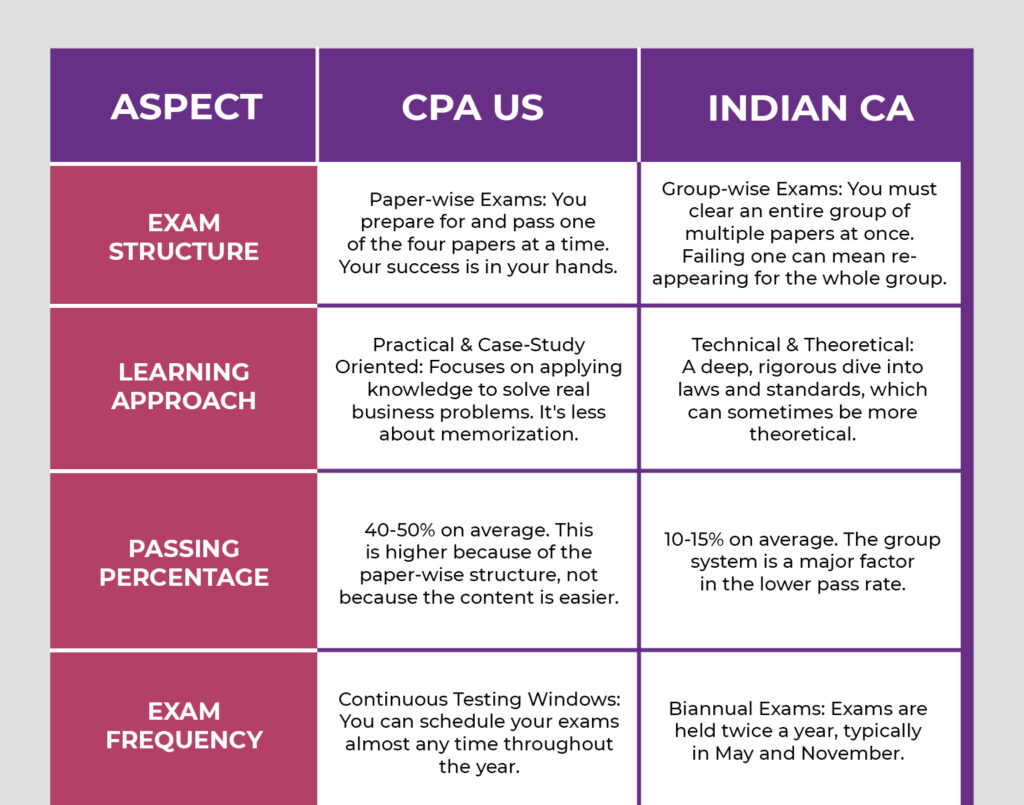
The Key Takeaway: The content and rigor of both qualifications are high. However, the CPA exam pattern offers a level of flexibility and practical focus that is ideally suited for working professionals who need to balance their studies with a demanding career. It allows you to progress at your own pace without the high-stakes pressure of an all-or-nothing group system.
One of the most significant hurdles for Indian aspirants is meeting the strict CPA US eligibility criteria. As Prakash Sir states, this is a “no free entry course.” You must fulfill specific educational requirements before you can even sit for the exams. Let’s break down the biggest component: the 120 credit hour rule.
In the US system, one year of Indian university education is typically evaluated as 30 credit hours.
This means that if you hold a 3-year bachelor’s degree, you fall short of the 120 credits required to appear for the exam. But don’t worry there is a clear path forward.
How to Bridge the 30-Credit Gap
Here are the most common pathways for Indian students to meet the 120 credit hour requirement:
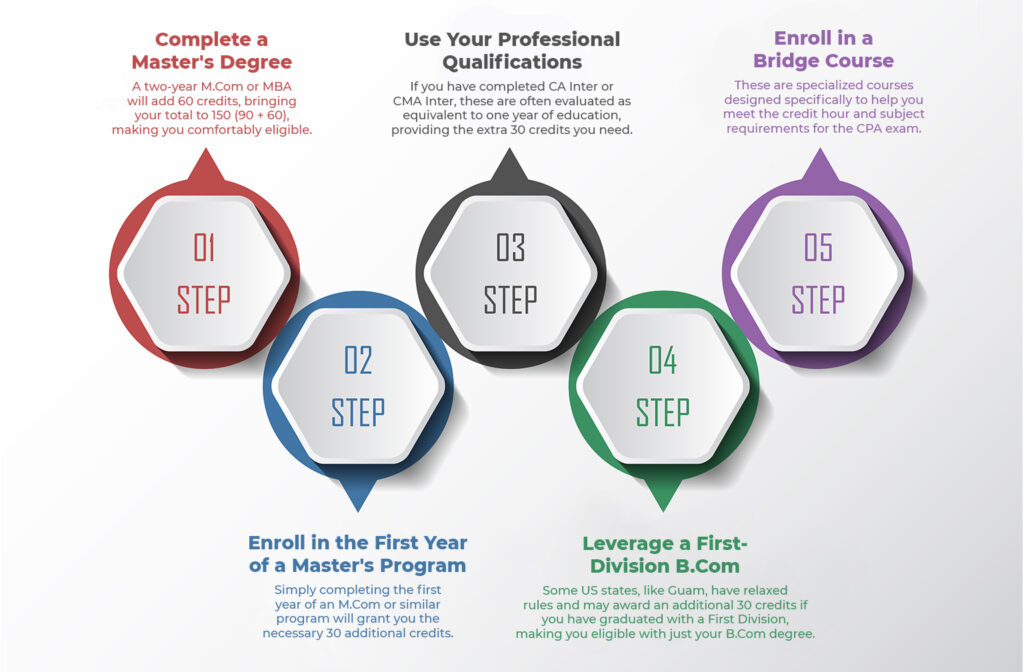
Navigating which state to apply through and getting your credentials evaluated is a complex process. At Saraf Academy, we provide expert, end-to-end guidance to ensure you find the most efficient and cost-effective path to eligibility.
The CPA US is a premium qualification, and it’s important to be honest about the investment required. As Prakash Sir puts it, the CPA is a “good costly course.” A clear understanding of the costs helps you plan your journey effectively.
The total CPA US fees in India will be approximately ₹4 Lakhs, spread over 12 to 18 months. This is not a single payment but a combination of fees paid to US bodies and your preparation providers.
Here is a transparent breakdown of the total estimated investment:
| Component | Paid To | Approx. Cost (USD) | Approx. Cost (INR) |
| Institute & Exam Fees | AICPA / NASBA / State Boards | $3,400 | ₹2.9 Lakhs |
| Certified Study Materials | Gleim (Saraf Academy’s Partner) | $600 | ₹50,000 |
| Expert Training & Coaching | Saraf Academy | $600 | ₹50,000 |
| Total Estimated Investment | $4506 | ₹4 Lakhs |
*Note: Institute and exam fees are paid in US Dollars ($). The Indian Rupee (₹) amount is an approximation based on current exchange rates and is subject to change.
Flexible Payment Options
We understand that this is a significant investment. To make it more manageable, Saraf Academy offers a no-cost EMI facility for our portion of the fees (Training + Materials). This allows you to spread the cost over six months without any interest burden, so you can focus on what truly matters your studies.
The next big question is: Is the CPA exam difficult? Prakash Sir gives a direct and honest answer: yes. He cautions students against a common misconception:
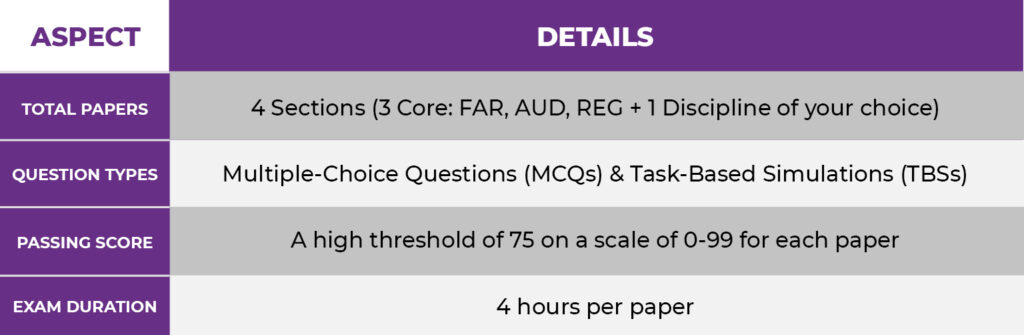
“The common notion in the students [is] multiple choice… multiple choice is the most difficult exam in the world. So US CPA exams are very difficult because they are entirely multiple-choice based and [the] pass mark [is] around 75% out of 100. It’s not easy to crack.”
Success on the CPA exam requires deep conceptual knowledge, not just memorization.Understanding the Exam Format
A Proven Strategy for Success
While the exam is tough, it is absolutely achievable for working professionals with the right strategy. The key isn’t to study more; it’s to study smarter and more consistently.
The CPA journey is a marathon, not a sprint. With the right discipline and expert guidance, you can confidently cross the finish line.
A premier qualification like the CPA US isn’t just an academic achievement; it’s a direct investment in a high-growth, high-income career. The opportunities for CPAs, both in India and globally, are expanding at an unprecedented rate.
The Rise of Global Capability Centers (GCCs) in India
One of the biggest drivers of CPA jobs in India is the explosion of GCCs. As Prakash Sir highlights:
“We have already in India 1200 plus global capability centers… they are basically the back office of US, UK, [and] so many countries’ companies… for service purpose.”
These GCCs of giants like Amazon, Morgan Stanley, and thousands of other US corporations need professionals who are fluent in US GAAP, US Auditing Standards, and US Tax Law. This has created a massive, high-paying job market for CPAs right here in India.
The Lucrative World of Freelancing
The CPA license is also your key to becoming a location-independent professional. With a global shortage of US tax and accounting experts, a huge market for freelance work has opened up.
CPA Salary in India: A Realistic Look
The CPA salary in India is among the highest in the finance and accounting profession, reflecting the specialized skills and global demand.
| Experience Level | Typical Role | Estimated Annual Salary (INR) |
| Fresher / Entry-Level | Associate at Big Four, Financial Analyst at MNC | ₹7 Lakhs – ₹10 Lakhs |
| Experienced (2-5 years) | Senior Associate, FP&A Analyst, Internal Auditor | ₹12 Lakhs – ₹20 Lakhs |
| Senior Level (5+ years) | Manager/Director at Big Four/MNC, Controller | ₹25 Lakhs+ |
The CPA exam is a rigorous test of your knowledge. In 2025, the exam evolved into a “Core + Discipline” model to better reflect the skills modern accountants need. Understanding this structure is the first step in your preparation.
The CPA exam pattern consists of four sections: three compulsory Core sections and one Discipline section of your choice.
The Core Sections (Compulsory for All)
The Discipline Sections (Choose One)
This is where you can specialize based on your career interests.
As Prakash Sir mentions, most students typically choose either BAR for a career in corporate finance or TCP for a specialization in taxation.
A journey as complex and demanding as the CPA US requires more than just study material; it requires a dedicated partner who can guide you through every hurdle. At Saraf Academy, we provide the end-to-end support system designed for the success of Indian professionals.
Here’s why Saraf Academy is the best CPA coaching in India:
From your first eligibility check to the day you earn your license, we are with you at every step.