Digital Transformation in Accounting [2026]: Why Data Skills Are Your Career Insurance
“Sir, will AI replace accountants?”
This is the single most common fear I (Prakash Saraf) hear from students in 2026. They read headlines about ChatGPT closing tax loopholes or bots handling audits, and they worry that the career they are studying for is vanishing.
Here is my honest answer: AI will not replace accountants. But accountants who use AI will replace those who don’t.
We are living through the biggest shift in the finance profession since the invention of the spreadsheet. The era of the “manual accountant”- the person who spends 8 hours a day entering data, reconciling bank statements, and formatting Excel sheets is officially over.
In 2026, the accounting profession has undergone a Digital Transformation. Data is the new oil, and the accountant is the new refinery.
As a mentor who has guided thousands of students through this transition, I (Prakash Saraf) want to show you exactly why data skills are no longer “optional”- they are your survival kit. In this definitive guide, we will explore the evolving landscape of digital finance, the specific tools you need to master, and how qualifications like the CMA (US) and ACCA are rewriting the rulebook to keep you relevant.
1. The “Why” Behind the Change: From Hindsight to Foresight
To understand why data skills matter, you have to understand what a CEO expects from a Finance team in 2026.
The Old World (Hindsight): The accountant’s job was to tell the CEO what happened last month. “Our sales were down 5%.” This is reporting.
The New World (Foresight): The CEO wants to know what will happen next month. “Based on our data trends, sales will drop 5% unless we increase marketing spend in Region X.” This is analytics.
The Data Revolution:
Every transaction a company makes creates data. Every invoice, every swipe of a credit card, every click on a website.
A traditional accountant ignores 90% of this data and focuses only on the general ledger.
A Digital Accountant uses this data to find patterns, predict cash flow issues, and identify fraud before it happens.
The Lesson: If you can only look backward, you are a historian. If you can look forward using data, you are a leader.
2. The New Toolkit: Why Excel is No Longer Enough
For 30 years, Microsoft Excel was the king of finance. If you knew VLOOKUP and Pivot Tables, you were a god.
In 2026, Excel is still there, but it is no longer the only tool in the shed. The volume of data companies generate today breaks Excel. You cannot load 10 million rows of sales data into a spreadsheet without it crashing.
The Modern Finance Stack:
Data Visualization (PowerBI / Tableau): You need to present data in dynamic dashboards, not static PDF reports. A CEO wants to click a button and see profitability by region instantly.
Database Management (SQL): You don’t need to be a developer, but you need to know how to “talk” to a database to pull the data you need without waiting for IT.
Automation (RPA – Robotic Process Automation): Bots now do the copy-pasting. Tools like UiPath handle invoice processing. You need to know how to manage the bot.
Cloud ERPs (SAP S/4HANA, Oracle NetSuite): Understanding how integrated cloud systems work is mandatory.
The Mentor’s Advice: You don’t need to learn code (like Java or C++). You need to learn Low-Code tools that help you manipulate data. Start with PowerBI. It is the new Excel.
3. The “Hybrid” Professional: The Accountant-Data Scientist
We are seeing the rise of a new job title: The Financial Data Scientist.
This is a professional who understands Debits and Credits (the language of business) AND Data Analytics (the language of technology).
Why this combination is rare and valuable:
A pure Data Scientist can build a model, but they don’t understand what “EBITDA” or “Working Capital” means. They might find a correlation that makes no financial sense.
A pure Accountant understands the P&L, but cannot handle the massive datasets required to analyze it deeply.
The Sweet Spot:
The professional who sits in the middle-who can validate the data and the accounting logic-is the most expensive asset in the finance department today.
4. How Automation Kills the “Boring” Work (And Why That’s Good)
Many students fear automation. They shouldn’t. They should celebrate it.
Think about the tasks you hate:
Matching invoices to purchase orders.
Manually typing data from a PDF into Excel.
Checking for duplicate payments.
Reconciling inter-company transactions.
RPA (Robotic Process Automation) eats these tasks for breakfast. In 2026, up to 80% of transactional accounting is automated.
The Opportunity:
Because the robot is doing the boring work, you get to do the interesting work much earlier in your career. Instead of spending your first 3 years as a “data entry clerk,” you spend them as a “Junior Analyst,” looking at the output and asking strategic questions.The Catch: If your only skill is “data entry,” you are obsolete. You must have the skills to analyze what the robot produces.
5. The Syllabus Shift: How CMA and ACCA Adapted
The global accounting bodies saw this coming years ago. They didn’t just update their syllabi; they revolutionized them.
CMA US (Certified Management Accountant): The IMA (Institute of Management Accountants) added a massive section to Part 1: Technology and Analytics.
It covers: Information Systems, Data Governance, Technology-Enabled Finance Transformation, and Data Analytics.
The Message: You cannot be a CMA without understanding tech.
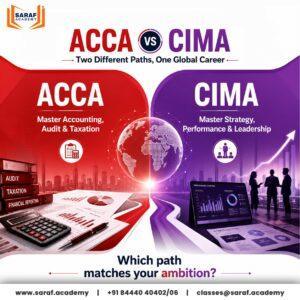
ACCA (UK): ACCA integrated “Digital Quotient” across its entire curriculum.
Papers like Business Technology (BT) and Strategic Business Leader (SBL) heavily feature big data, cloud computing, and e-business models.
The Message: A modern chartered accountant must be a digital native.
My Advice: Do not choose a course that is stuck in the 1990s. Choose a qualification like CMA or ACCA that forces you to learn these modern skills. It is your career insurance.
6. Risk Management in the Digital Age: Cybersecurity & Governance
With great data comes great responsibility.
As finance teams become the custodians of massive amounts of sensitive data, the risk profile changes. The CFO is now often responsible for Cybersecurity Risk.
New Skills Required:
Data Governance: Ensuring data is accurate, consistent, and secure. “Garbage in, Garbage out” destroys financial models.
Internal Controls for AI: How do you audit an algorithm? If an AI predicts revenue, how do you verify it’s correct?
Privacy Laws: Understanding GDPR (Europe) or DPDP (India) is now an accounting issue, not just a legal one.
The Lesson: You need to be the “Digital Guardian.” You must ensure that while the company moves fast with tech, it doesn’t crash due to poor controls.
7. The “Data Premium”: Impact on Salary and Career Growth
Let’s talk money. Does knowing PowerBI actually get you paid more?
Yes.
In 2026, recruiters are using a filter. They are looking for “Accountants with Analytics.”
The Standard Accountant: Competes with thousands of others. Salary growth is standard (10-15% per year).
The Tech-Enabled Accountant: Competes in a niche pool.
Salary Premium: Often 20-30% higher starting salary.
Growth: Faster promotion to Manager/Controller because they drive efficiency projects that save the company money.
Real World Example:
An accountant who manually prepares a monthly report takes 2 days. An accountant who automates it using SQL and PowerBI takes 2 minutes. Who do you think gets the promotion?
8. Case Study: How Netflix and Amazon Use “Digital Accounting”
To see the future, look at the giants.
Netflix: Their finance team doesn’t just count subscriptions. They use data analytics to predict the ROI of Content. They analyze viewing patterns to tell the production team: “If you spend $100M on this sci-fi show, we predict it will bring in 500k new subscribers.” That is finance driving strategy.
Amazon: Their “Touchless Financial Close.” Amazon has automated so much of its ledger that they can close their books in record time with minimal human intervention. Their finance talent focuses entirely on optimizing the supply chain and pricing models.
The Lesson: This is where the industry is going. Small companies will follow the giants. Be ready.
9. Your Roadmap: How to Future-Proof Your Career Today
You don’t need to go back to college to get a Computer Science degree. You just need to layer skills on top of your accounting foundation.
My 4-Step Action Plan:
Get the Core Qualification: You must have the accounting base. CMA US or ACCA are non-negotiable. They give you the “Accounting” half of the equation.
Master One Visualization Tool: Spend one month learning Microsoft PowerBI. It is free to start, and it integrates with Excel. Learn to turn a spreadsheet into a dashboard.
Learn the Basics of Data: Take a short online course on “Data Analytics for Business.” Understand terms like “Regression Analysis,” “Correlation,” and “Predictive Modeling.”
Be Curious: In your current job or internship, ask: “Can this be automated?” “Is there a better way to report this?” Be the person who brings the solution.
The Final Word:
Digital transformation is not a wave that will pass. It is the new ocean. You can either learn to swim in it, or you can sink with the manual processes of the past.
The choice is yours.
Equip Yourself for the Future with Saraf Academy!🚀
At Saraf Academy, we don’t just teach from the textbook; we prepare you for the real world of 2026.
Our CMA US and ACCA programs are designed with a “Digital First” mindset.
Tech-Integrated Learning: We discuss how the syllabus concepts apply in a tech-driven environment.
Practical Insights: Our faculty includes industry experts who use these tools daily.
Future-Ready Curriculum: We ensure you master the “Technology and Analytics” sections of the exams, not just memorize them.
Don’t let the future leave you behind. Upgrade your skills today.