
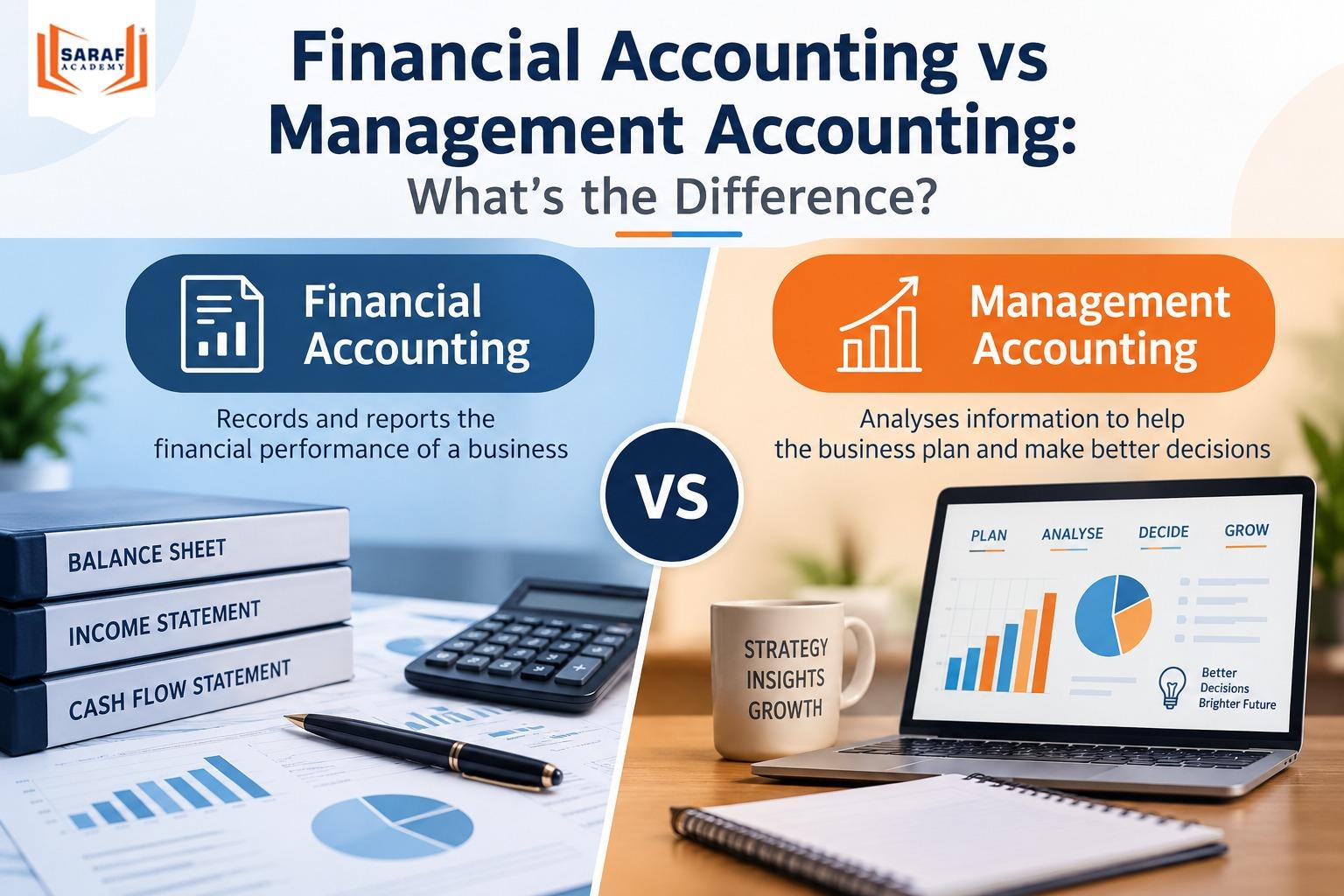
Financial accounting vs management accounting is an important distinction for students and professionals planning a career in accounting and finance. Both areas use financial information, but they serve different purposes.
When you think about accounting, you may think of recording transactions, preparing reports and calculating profit. But accounting also plays an important role in helping businesses understand their performance and make better decisions.
This is where financial accounting and management accounting come in. Financial accounting focuses mainly on reporting a company’s financial performance and position, while management accounting focuses on analysing financial and business information for planning and internal decision-making.
If you are considering a career in accounting or finance, understanding the difference between financial accounting and management accounting can help you identify which type of work may suit your interests and career goals.
Please Read: ACCA or US CMA? Choose the right path.
Financial accounting is the process of recording, classifying, summarising and reporting the financial transactions of a business.
It converts day-to-day transactions such as sales, purchases, expenses, payments and receipts into organised financial information.
Some of the key financial statements include:
● Balance Sheet
● Profit and Loss Statement
● Cash Flow Statement
● Notes to Financial Statements
These reports help stakeholders understand the financial health and performance of a company.
Who Uses Financial Accounting Information?
Financial accounting is particularly important for external stakeholders, such as:
● Investors
● Shareholders
● Banks and lenders
● Creditors
● Government authorities
● Regulators
● Auditors
For example, a bank may examine a company’s financial statements before deciding whether to provide a loan.
Management accounting focuses on analysing financial and business information to help management plan, control and make decisions.
Instead of simply reporting numbers, management accountants try to understand what those numbers mean for the business.
They may analyse:
● Costs
● Revenue
● Budgets
● Profit margins
● Sales performance
● Forecasts
● Variances
● Key performance indicators (KPIs)
For example, a company may notice that sales have increased but profits have fallen.
Management accounting can help identify whether the reason is higher production costs, increased discounts, rising employee expenses or poor performance from a particular product
or department.
What Questions Does Management Accounting Answer?
It can help management understand:
● Which products are most profitable?
● Where are costs increasing?
● Are we meeting our budget?
● Why is actual performance different from the forecast?
● Should we change our pricing?
● Should we increase production?
● Which department needs improvement?
| Basis | Financial Accounting | Management Accounting |
|---|---|---|
| Purpose | Records and reports the financial activities and results of a business. | Analyses financial and business information to support planning and decision-making. |
| Main Users | Investors, shareholders, banks, creditors, regulators and other external stakeholders. | Managers, CFOs, department heads and other internal decision-makers. |
| Main Focus | Financial performance, financial position and reporting. | Business performance, cost control, profitability and future planning. |
| Time Perspective | Primarily focuses on transactions and performance that have already occurred. | Uses past and current information to support future planning and forecasting. |
| Reports | Balance Sheet, Profit & Loss Statement, Cash Flow Statement and other financial reports. | Budgets, forecasts, variance reports, cost analysis, KPI reports and management reports. |
| Reporting Rules | Generally follows applicable accounting standards and reporting requirements. | Reports are usually designed according to the specific needs of management. |
| Level of Detail | Usually provides an overall view of the organisation’s financial performance. | Can focus on a specific product, branch, department, project or business segment. |
| Frequency | Usually prepared according to a regular reporting cycle. | Prepared whenever management needs information for a particular decision or analysis. |
| Information Used | Mainly financial and transaction-related information. | Financial information combined with operational and business information. |
| Decision Support | Helps stakeholders evaluate the financial health of a business. | Helps management make decisions related to pricing, budgeting, costs, expansion and resources. |
| Career Areas | Accounting, financial reporting, audit, taxation and financial control. | Management accounting, FP&A, business finance, performance analysis and strategic finance. |
| Key Question | “What happened financially?” | “Why did it happen, and what should we do next?” |
Financial accountants are primarily responsible for maintaining a company’s financial records and preparing accurate reports. Their work ensures that financial transactions are properly recorded and
that the organisation meets applicable reporting and compliance requirements.
Key responsibilities include:
Management accountants use financial and operational information to help businesses understand performance and make informed decisions. Their work focuses on analysis, planning and improving business performance.
Key responsibilities include:
Financial accounting professionals can benefit from:
Management accounting requires accounting knowledge along with broader business skills, including:
A career in financial accounting requires a good understanding of accounting principles, financial reporting, taxation and compliance. Students from commerce, accounting or finance backgrounds can explore this field, while professional qualifications can help build specialised knowledge and improve career opportunities.
Some qualifications you can consider include:
ACCA
A globally recognised accounting qualification covering financial accounting, financial reporting, audit, taxation and financial management.
Watch This: https://www.youtube.com/shorts/m_U3sgbWuPs
US CPA
Particularly relevant for professionals interested in accounting and finance roles connected with the US market, with a strong focus on US accounting practices.
Watch This: https://www.youtube.com/watch?v=Yvu7wEey1D4
Chartered Accountancy (CA)
Provides comprehensive knowledge of accounting, auditing, taxation and financial reporting, making it relevant for several accounting and reporting careers.
B.Com / M.Com / MBA in Finance
These academic programmes can provide a foundation in accounting and finance and may lead to opportunities in accounting, corporate finance and related roles.
Management accounting requires more than accounting knowledge. Professionals also need skills in financial analysis, budgeting, forecasting and business decision-making.
Some qualifications that can support a career in this area include:
US CMA
Focuses strongly on management accounting, cost management, budgeting, financial analysis, performance management and strategic decision-making.
Watch This: https://www.youtube.com/watch?v=ysUY6EBTnVs
CMA India
Covers areas related to cost accounting, cost control, financial planning and management decision-making, making it relevant to management accounting roles in India.
CIMA
Has a strong focus on management accounting, business performance, strategy, risk and decision-making.
Watch This: https://www.youtube.com/watch?v=u8xWC-hKaoQ
MBA in Finance
Combines financial knowledge with management and business skills, which can be useful for professionals interested in corporate finance and strategic roles.
A qualification in accounting can open the door to a wide range of career opportunities in India and abroad. Depending on your interests and professional qualification, you can build a career in financial reporting, auditing, taxation, corporate finance and related areas.
Management accounting offers career opportunities for professionals interested in financial analysis, budgeting, forecasting, business performance and strategic decision-making.
Financial Accounting May Suit You If You Enjoy:
Management Accounting May Suit You If You Enjoy:
However, these are not fixed career paths. A professional can start in financial accounting and later move into management accounting, FP&A, corporate finance or other areas by developing the required skills.
The difference between financial accounting and management accounting is simple: financial accounting focuses on reporting financial performance, while management accounting focuses
on analysis, planning and decision-making.
For students, understanding this difference can help them choose the right career path and professional qualification.
At Saraf Academy, we help students make informed choices about their accounting careers and professional qualifications.
Financial accounting mainly focuses on recording and reporting financial information, while management accounting analyses financial and business information to support internal planning and decision-making.
No. Both use accounting information, but their objectives are different. Financial accounting is mainly focused on reporting, while management accounting focuses more on analysis, planning and decision support.
Neither is universally better. Financial accounting may suit someone interested in reporting, accounting and audit, while management accounting may be better suited to someone interested in analysis, forecasting and business strategy.
A financial accountant may maintain accounting records, prepare financial statements, perform reconciliations, support audits and assist with financial reporting.
What does a management accountant do?
A management accountant may work on budgeting, forecasting, cost analysis, varianceanalysis, profitability, financial modelling and business performance.
Yes. Financial accounting provides a strong foundation. By developing skills in budgeting, forecasting, data analysis and business decision-making, professionals can
move into management accounting and related finance roles.