
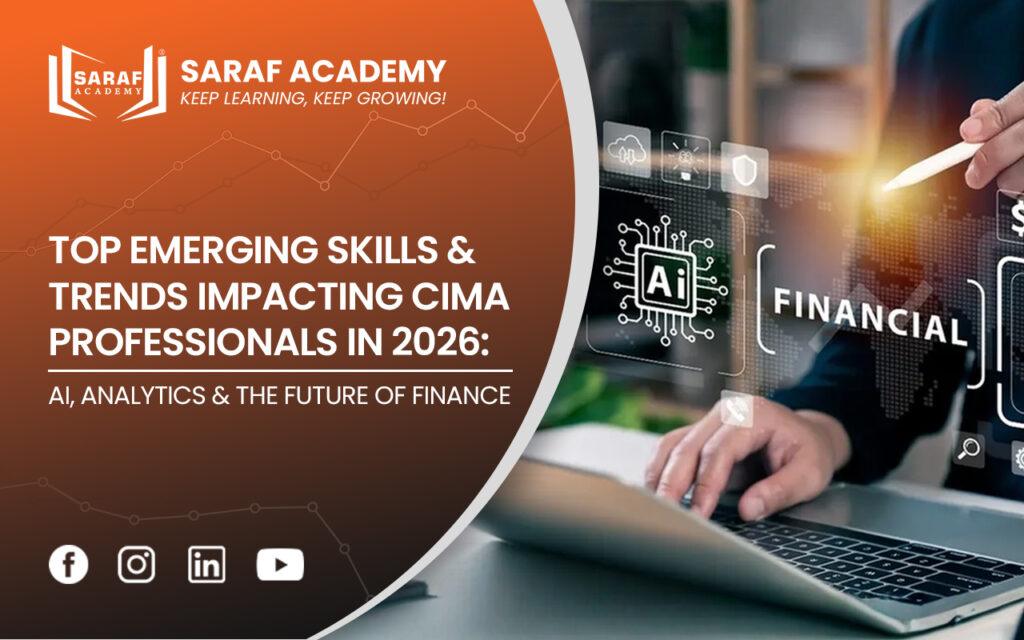
The role of the management accountant is evolving faster than at any point in recent history. As we move into 2026, CIMA professionals are no longer just financial stewards—they are expected to be strategic partners, data-driven decision-makers, and leaders in digital transformation.
Driven by advances in AI, automation, big data, and predictive analytics, the CIMA syllabus and real-world expectations are shifting in line with discussions emerging from AICPA-CIMA thought leadership and global finance trends.
So what skills will truly differentiate successful CIMA professionals in 2026 and beyond?
Let’s break it down.
1. AI & Automation: Redefining Financial Reporting and Decision-Making
Artificial Intelligence is no longer a future concept—it’s embedded in modern finance functions.
How AI is transforming management accounting
AI and automation are increasingly used to:
Recent AICPA-CIMA discussions highlight a clear shift:
👉 Finance professionals are expected to understand, oversee, and interpret AI outputs—not just produce reports.
What this means for CIMA professionals
CIMA members don’t need to become data scientists—but they must understand:
Key emerging skill: AI-enabled financial judgment
2. Digital Transformation & Big Data: Finance as a Strategic Enabler
Digital transformation is no longer an IT initiative—it’s a finance leadership responsibility.
Big data meets management accounting
Modern organisations generate vast amounts of data from:
CIMA professionals are expected to:
Predictive analytics in finance leadership
Predictive analytics goes beyond historical reporting by:
This aligns strongly with CIMA’s focus on performance management, business strategy, and value creation.
Key emerging skill: Data-driven storytelling for strategic impact
3. From Scorekeeper to Strategic Partner: The New Finance Mindset
The traditional “scorekeeper” role is fading fast.
Finance leaders as decision architects
In 2026, high-performing CIMA professionals will:
This requires:
Key emerging skill: Commercial decision-making under uncertainty
4. Strategic Risk Management in an Uncertain World
Risk is no longer just about compliance—it’s about resilience.
Expanding the risk agenda
Modern organizations face:
CIMA professionals are expected to:
This represents a shift from reactive risk reporting to proactive risk leadership.
Key emerging skill: Enterprise-wide strategic risk integration
5. How the CIMA Syllabus Is Evolving to Meet These Demands
The CIMA qualification is increasingly aligned with real-world finance leadership needs:
Students who develop skills beyond exam technique—especially in analytics, AI awareness, and strategic thinking—will stand out in the market.
Final Thoughts: The CIMA Professional of 2026
The future CIMA professional is:
✔ Tech-aware, not tech-replaced
✔ Data-literate, not data-overwhelmed
✔ Strategically minded, not operationally confined
AI, analytics, and digital transformation aren’t threats—they’re career accelerators for management accountants who adapt early.
For CIMA students and members, the message is clear:
Master the numbers—but lead with insight.